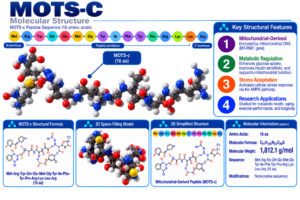
MOTS-c is a linear 16-amino-acid mitochondrial-derived peptide encoded by a short open reading frame associated with mitochondrial 12S rRNA. Its sequence is Met-Arg-Trp-Gln-Glu-Met-Gly-Tyr-Ile-Phe-Tyr-Pro-Arg-Lys-Leu-Arg. The peptide contains two methionine residues, aromatic tryptophan, phenylalanine and tyrosine residues, and multiple basic arginine and lysine residues. PubChem represents the peptide as H-MRWQEMGYIFYPRKLR-OH.
Metabolic stress / folate-purine-AMPK signaling network A single conventional receptor target has not been established in the same way as for receptor agonist peptides such as Ipamorelin or Tesamorelin. Experimental research instead associates MOTS-c with: Folate-cycle regulation → de novo purine metabolism → AICAR accumulation → AMPK activation and with metabolic-stress-dependent nuclear translocation and gene regulation.
HEK293 cellular models
C2C12 skeletal-muscle cells
Mouse skeletal-muscle models
High-fat-diet mouse models
Age-associated mouse models
Metabolic-stress cell systems
Nuclear-translocation models
Human skeletal-muscle/exercise research
Metabolomic experimental systems
Gene-expression profiling systems
The original discovery work used cellular and mouse metabolic models, while later work examined exercise-induced MOTS-c expression in humans and skeletal-muscle adaptation in mice.
For the actual OPTMZ product, the directly measured analytical endpoints were chromatographic purity, identity, and MOTS-c content.
Mechanism / Research Context
MOTS-c is a mitochondrial-derived signaling peptide involved experimentally in metabolic adaptation and communication between mitochondrial and nuclear pathways.
The original discovery study found that MOTS-c alters one-carbon metabolism, particularly the folate cycle and its linked de novo purine synthesis pathway. This produces accumulation of AICAR, an endogenous AMP analog capable of activating AMPK, a central cellular energy sensor.
Experimental studies also show that MOTS-c can increase cellular glucose uptake and redirect glucose-derived carbon toward the pentose-phosphate and purine pathways.
Under metabolic stress, MOTS-c has also been investigated for its ability to translocate to the nucleus and participate in adaptive nuclear gene regulation, illustrating a potential mitochondrial-to-nuclear signaling mechanism.
Evidence Level
Preclinical Research / Early Human Physiological Research The strongest mechanistic evidence for MOTS-c comes from biochemical, cellular, and animal studies. Human research has investigated endogenous MOTS-c responses, including exercise-associated changes, but this should not be interpreted as established clinical efficacy of administered MOTS-c.
Research References
Lee C, et al. The mitochondrial-derived peptide MOTS-c promotes metabolic homeostasis and reduces obesity and insulin resistance. Cell Metabolism. 2015;21(3):443-454. PMID: 25738459. DOI: 10.1016/j.cmet.2015.02.009. Reynolds JC, et al. MOTS-c is an exercise-induced mitochondrial-encoded regulator of age-dependent physical decline and muscle homeostasis. Nature Communications. 2021;12:470. DOI: 10.1038/s41467-020-20790-0. MOTS-c review: Review of mitochondrial-derived peptide biology, cellular signaling, mitochondrial-nuclear communication, and metabolic research. PMID: 36761202. PubChem CID 146675088: MOTS-c molecular formula, molecular weight, sequence, CAS number, and structural information.
Analytical Characterization
Independent analytical testing of OPTMZ Peptides MOTS-c 10 mg, lab sample 200512, by Krause Analytical reported:
Chromatographic Purity: 98.96%
MOTS-c Content: 9.64 mg
Label Claim: 10 mg
Percent of Label: 96.4%
Identity: Confirmed
CAS Number: 1627580-64-6
Analysis Method: HPLC-UV-MS
Lab Number: 200512
Project: 145030
Date Received: January 29, 2026
Report Issued: February 6, 2026
Endotoxin Testing: Not reported on current COA
These results come directly from the Krause Analytical Certificate of Analysis.
The lot-specific purity, measured content, identity, and CAS number come directly from the Krause Analytical COA.
PubChem reports MOTS-c as a 16-residue peptide with sequence MRWQEMGYIFYPRKLR, formula C₁₀₁H₁₅₂N₂₈O₂₂S₂, molecular weight 2174.6 g/mol, and CAS 1627580-64-6.
Analytical & Testing
Each tested batch of MOTS-c undergoes analytical evaluation to verify chromatographic purity, identity, peptide content, and analytical consistency.
For the submitted OPTMZ Peptides sample, Krause Analytical reported:
Chromatographic Purity: 98.96%
Identity: MOTS-c — Confirmed
Measured Content: 9.64 mg
Label Claim: 10 mg
Percent of Label: 96.4%
Testing Method: HPLC-UV-MS
CAS Number: 1627580-64-6
Lab Number: 200512
Project: 145030
The laboratory states that the data presented are from the analyzed sample and meet its internal quality-assurance criteria unless otherwise flagged.
Endotoxin Status:Not reported on this COA. This lot should therefore not be described as endotoxin-tested or endotoxin-passing based on the supplied document.
Handling & Storage
MOTS-c should be handled by qualified professionals in controlled laboratory environments. Appropriate storage conditions should be maintained to preserve peptide stability and structural integrity.
Avoid unnecessary exposure to heat, moisture, light, and repeated temperature fluctuations. Experimental preparation, storage, and handling should follow validated laboratory procedures appropriate to the intended research application.
Research Context
MOTS-c is investigated primarily in mitochondrial biology, cellular metabolism, and adaptive stress signaling.
Research areas include:
Mitochondrial-derived peptide biology
Mitochondrial-to-nuclear signaling
AMPK-associated signaling
Folate-cycle metabolism
De novo purine biosynthesis
AICAR-associated pathways
Skeletal-muscle metabolism
Cellular glucose utilization
Metabolic stress adaptation
Nuclear gene-expression regulation
Exercise-associated signaling
Cellular energy homeostasis
Aging-associated metabolic research
The original MOTS-c discovery study identified the peptide as a 16-amino-acid mitochondrial-derived peptide and reported that its cellular effects involved inhibition of the folate cycle and linked de novo purine biosynthesis, leading to AICAR accumulation and AMPK activation.
Subsequent research found that metabolic stress can promote MOTS-c nuclear translocation and adaptive nuclear gene regulation. Research in humans and mice has also examined MOTS-c in relation to exercise, skeletal-muscle metabolism, physical performance, and age-associated physiological decline.
These findings describe experimental and preclinical research and do not establish therapeutic efficacy or safety of the OPTMZ research product.
Research Application Scope
MOTS-c is relevant to controlled experimental investigations involving mitochondrial signaling, metabolic stress responses, AMPK-associated pathways, folate-purine metabolism, skeletal-muscle biology, mitochondrial-nuclear communication, and cellular energy regulation.
Its unusual origin within the mitochondrial genome makes MOTS-c particularly relevant to research examining how mitochondria function not only as metabolic organelles but also as sources of signaling peptides capable of influencing cellular and nuclear pathways.
Use Statement
For laboratory research use only. Intended strictly for in vitro and controlled experimental research applications.
Disclaimer
All products currently listed on this site are for research purposes ONLY.




Reviews
There are no reviews yet.