Lot White Cap · Freedom Diagnostics · reported 30 August 2026 . The bar shows where the reported result falls against Astramide’s published release criterion. The notch marks the criterion.
Within criterionAbove criterionNot on this COA
Test
Method
Criterion
Result
Result vs criterion
Status
Identity
LC-MS
LC-MS match to the labelled component
Benzyl Alcohol
WITHIN SPEC
Chromatographic purity
HPLC-UV
at or above 98.0%
99.98%
95at or above 98.0%100
WITHIN SPEC
Benzyl alcohol content
HPLC-UV
0.9% nominal, as reported by the laboratory
0.95%
00.9% nominal, as reported by the laboratory2
WITHIN SPEC
Endotoxin
LAL, USP <85>
below the 0.05 EU/mL assay sensitivity
Pass, 2 of 2 at ≤0.05 EU/mL
WITHIN SPEC
Appearance
Visual
clear liquid
Clear Liquid
WITHIN SPEC
Values are reported per vial or bottle unless otherwise noted. Every figure here is taken from the batch Certificate of Analysis and nothing else.
Certificate of Analysis
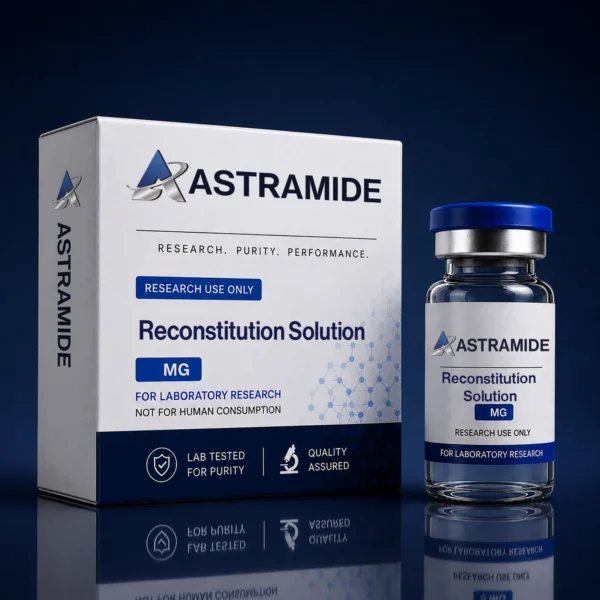
Reconstitution Solution · Lot White Cap · Lab No. 2608270451
Freedom Diagnostics · 1 page · served inline, not a screenshot
Quick reference
How to read this report
Same six keys on every Astramide product page. Only the values change.
1Lot numberMatch it to the number printed on your product label. If they differ, this report is not for your product.
2IdentityMass spectrometry confirms the molecule is the one on the label. It conforms or it does not. There is no partial result.
3Chromatographic purityThe share of the material that is the target peptide. A purity figure quoted without a method is not a purity figure.
4Net contentHow much compound is in each vial or bottle, as measured by the laboratory. A different question from purity.
5EndotoxinMeasured against a ceiling, not a floor. Sensitivity differs by laboratory, so results are not compared across labs.
6Laboratory, method, dateWho ran it, on what instrument, and when. A report with no named laboratory or no date is not a report.
Molecular profile
Reconstitution Solution, in structural terms.
Sequence
Not applicable. Reconstitution Solution is a solvent, not a peptide, and has no amino acid sequence.
Molecular formula
C₇H₈O (benzyl alcohol); the bulk component is water, H₂O
Molecular weight
Benzyl alcohol: approximately 108.14 g/mol
CAS number
100-51-6 (benzyl alcohol)
Structure type
Reagent
Primary molecular target
No molecular target. Benzyl alcohol acts by partitioning into microbial cell membranes and disrupting membrane integrity, a physicochemical mechanism rather than receptor binding. The solution is a diluent and is not itself under investigation as an active compound.
Reconstitution Solution is water containing benzyl alcohol at a nominal 0.9% as a bacteriostatic agent. It is a two-component solution rather than a single compound. Benzyl alcohol (C7H8O, about 108.14 g/mol) is an aromatic alcohol that inhibits microbial growth, which is why it is used as a preservative in laboratory diluents. The figures for formula, weight and CAS on this page describe benzyl alcohol, the active component.
Research profile
Where Reconstitution Solution appears in the literature.
Benzyl alcohol is one of the most studied preservatives in formulation science, because the property that inhibits microbial growth can also affect the stability of dissolved proteins and peptides.
Studies of a reconstituted lyophilized protein formulation found that benzyl alcohol increased protein aggregation, and that the effect depended on concentration and storage conditions (Roy et al., 2005). Related work traced the aggregation to partial unfolding of the protein in the presence of benzyl alcohol (Zhang et al., 2004).
Benzyl alcohol can also be lost from solution by sorption into flexible tubing and other polymeric materials, which changes its effective concentration (Bahal and Romansky, 2002). These studies are why the measured benzyl alcohol content of each lot is reported on its certificate.
These are published research systems. They do not describe approved clinical applications, and they do not establish efficacy or safety in humans.
Cited literature
Zhang Y et al., 2004. Mechanism for benzyl alcohol-induced aggregation of recombinant human interleukin-1 receptor antagonist in aqueous solution. J Pharm Sci. PMID 15514986. https://pubmed.ncbi.nlm.nih.gov/15514986/
Roy S et al., 2005. Effects of benzyl alcohol on aggregation of recombinant human interleukin-1-receptor antagonist in reconstituted lyophilized formulations. J Pharm Sci. PMID 15614819. https://pubmed.ncbi.nlm.nih.gov/15614819/
Bahal SM, Romansky JM, 2002. Sorption of benzoic acid, sorbic acid, benzyl alcohol, and benzalkonium chloride by flexible tubing. Pharm Dev Technol. PMID 11852696. https://pubmed.ncbi.nlm.nih.gov/11852696/
Evidence level
Benzyl alcohol as a bacteriostatic excipient has a long and well-replicated literature in formulation science, including compendial standards and peer-reviewed reviews of preservative use. Statements on this page describe the material and its analytical characterisation. This solution is supplied for laboratory research use only.
Handling and storage
As supplied
Solution in a sealed container, as stated on the product label.
Storage
Store per the conditions printed on the label. Keep tightly closed and protected from light and heat.
Handling
For qualified professionals in controlled laboratory environments, following validated laboratory procedures.
Frequently asked questions
About this compound and its batch data.
What is Reconstitution Solution?
Reconstitution Solution is water containing benzyl alcohol at a nominal 0.9% as a bacteriostatic agent. Benzyl alcohol is CAS 100-51-6, C7H8O, 108.14 g/mol. Astramide supplies it in 3 mL vials as a laboratory diluent for reconstituting lyophilized material. It is not intended for human or animal consumption, clinical use, or therapeutic application.
What is Reconstitution Solution used for in the laboratory?
It is used to bring lyophilized research materials into solution for laboratory work. The benzyl alcohol inhibits microbial growth, so a prepared solution can be kept and sampled over a working period under refrigeration rather than being discarded after a single use. Research use only.
What purity does the current Reconstitution Solution lot reach?
Lot White Cap returned 99.98% chromatographic purity by HPLC-UV, tested by Freedom Diagnostics under accession 2608270451 and reported 30 August 2026. Identity was confirmed by LC-MS as benzyl alcohol. The full certificate is published on this page and every figure shown here is taken from it.
How much benzyl alcohol is in the vial?
The laboratory measured 0.95% benzyl alcohol against a nominal 0.9% specification. Astramide publishes the measured figure rather than the nominal figure. Note that this is a concentration, not a net weight: unlike a lyophilized peptide, a solution is characterised by component percentage rather than milligrams per vial.
How is Astramide's Reconstitution Solution tested?
Testing is performed by Freedom Diagnostics. Lot White Cap was analysed by four methods: identity by LC-MS, chromatographic purity by HPLC-UV, benzyl alcohol content by HPLC-UV, and endotoxin by Limulus Amebocyte Lysate under USP 85. Both endotoxin replicates passed at an assay sensitivity of 0.05 EU/mL or below.
How should Reconstitution Solution be stored?
Store at controlled room temperature, protected from light, with the closure intact. Storage conditions printed on the vial label take precedence. Handling is for qualified professionals in controlled laboratory environments following validated procedures. Discard if the solution shows any cloudiness or particulate matter.
What is the difference between research-grade and pharmaceutical-grade Reconstitution Solution?
They are distinct classifications. Research-grade material is supplied for laboratory research use only and is characterised by the analytical panel published on this page. Pharmaceutical-grade is a separate regulatory classification governing material intended for human use. Astramide supplies research-grade material and makes no pharmaceutical-grade claim.
Does benzyl alcohol affect peptide stability?
Published formulation research has examined this directly. Antimicrobial excipients can promote reversible association of peptides in solution, and benzyl alcohol is subject to sorption by some container materials (Meyer et al., 2007, PMID 17722087; Bahal et al., 2002, PMID 11852696). Researchers designing extended storage protocols should account for both effects.
Research use only
This product is intended strictly for in-vitro laboratory research conducted by qualified professionals.
It is not intended for human or animal consumption, clinical use, or therapeutic application.
The statements on this page have not been reviewed by the FDA. These research peptides are not intended
to diagnose, treat, cure, or prevent any disease. Research Use Only.
We use analytics and advertising tools to understand how visitors find us and which campaigns work. You can turn either off. Your choice is saved in this browser.
AnalyticsGoogle Analytics, Microsoft Clarity and order source tracking. Helps us see how the site is used and fix problems.
Off (browser signal)
AdvertisingMeta and X pixels, and server-side events. Opting out also opts you out of "sharing" and targeted advertising under state privacy laws.
Off (browser signal)
Your browser is sending a Global Privacy Control signal, so analytics and advertising are off. To change this, turn off the signal in your browser settings.
Strictly necessary cookies (cart, sign-in, checkout, entry acknowledgment) always stay on. See our Privacy Policy.
Know what's in it before you order.
Every Astramide batch is tested by an independent US lab. The report goes public before the batch goes on sale, so you can check the numbers first.
Independent US lab test on every batch
Full report published before it goes on sale
Kept frozen, shipped from Austin, Texas
GLP-3RLot 2026/02 · May 8, 2026
>99.9%purity by HPLC-UV/MS
90%Minimum 98.0%100%
Identity: Confirmed by mass specEndotoxin: Below 0.5 EU/mL

 Pro Series
 Pro Series