Methylene Blue Pro
$24.99
VERIFICATION
How to read this report
Methylene Blue Pro, in structural terms.
- Sequence
- Not applicable. Methylene blue is a small-molecule dye, not a peptide, and has no amino acid sequence.
- Molecular formula
- C₁₆H₁₈ClN₃S
- Molecular weight
- Approximately 319.9 g/mol (anhydrous chloride)
- CAS number
- 61-73-4
- Structure type
- Reagent
- Parent sequence
- Not applicable. Methylene blue is a synthetic small-molecule dye, not a peptide or a fragment of one.
- Primary molecular target
- Methylene blue has no single receptor target. Published biochemical studies have examined its inhibition of nitric oxide synthase and soluble guanylate cyclase, its reversible inhibition of monoamine oxidase A (MAO-A), and its behavior as an electron carrier in isolated mitochondria.
- Physical form
- Solution
- PubChem CID
- 6099
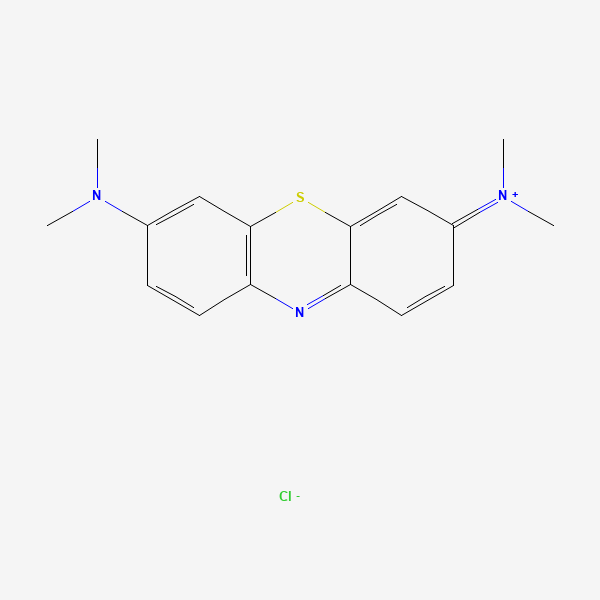
Methylene blue is a small-molecule phenothiazinium dye, 3,7-bis(dimethylamino)phenothiazin-5-ium chloride. It is not a peptide. Its tricyclic aromatic core carries a delocalized positive charge, which gives the oxidized form its deep blue color. It accepts electrons to form leucomethylene blue, a colorless reduced form, and this reversible redox behavior is the basis for much of its use as a laboratory reagent.
Where Methylene Blue Pro appears in the literature.
- Published studies have used methylene blue in:
- Nitric oxide synthase and nitric oxide-cGMP pathway studies
- Guanylate cyclase activity studies
- Monoamine oxidase enzyme inhibition studies
- Mitochondrial bioenergetics and electron transport studies
- Redox indicator and electron-acceptor chemistry
- Purified and partially purified enzyme preparations
- Isolated cerebral arterioles in animal models
- Isolated mouse brain mitochondria
- Cell-free redox assay systems
- Nitric oxide synthase activity assays
- cGMP and guanylate cyclase activity measurement
- Monoamine oxidase inhibition kinetics
- Mitochondrial respiration measurement
- HPLC-DAD for identity, purity and concentration
- Nitric oxide synthase activity
- Guanylate cyclase activity and cGMP levels
- MAO-A inhibition kinetics
- Mitochondrial bioenergetic parameters
- Oxidized and reduced (leuco) dye ratios
What has been studied, and in what systems.
Methylene blue has a long history in the laboratory as a stain and redox indicator, and it remains a common tool reagent in biochemistry.
In enzyme studies, methylene blue inhibited nitric oxide synthesis by acting on nitric oxide synthase directly, in addition to its known effects on soluble guanylate cyclase (Mayer et al., 1993). Work in cerebral arterioles of animal models found that its inactivation of guanylate cyclase depended on the generation of hydroxyl radicals (Kontos and Wei, 1993).
Enzyme kinetic studies have shown that methylene blue is a potent, reversible inhibitor of monoamine oxidase A (Ramsay et al., 2007). More recent work in isolated mouse brain mitochondria has compared the effects of methylene blue and its metabolite azure I on bioenergetic parameters (Gureev et al., 2022). These studies place methylene blue in redox biochemistry, enzymology and mitochondrial research.
These are published research systems. They do not describe approved clinical applications, and they do not establish efficacy or safety in humans.
Mayer B, Brunner F, Schmidt K, 1993. Inhibition of nitric oxide synthesis by methylene blue. Biochem Pharmacol. PMID 7679577. https://pubmed.ncbi.nlm.nih.gov/7679577/
Kontos HA, Wei EP, 1993. Hydroxyl radical-dependent inactivation of guanylate cyclase in cerebral arterioles by methylene blue and by LY83583. Stroke. PMID 8095358. https://pubmed.ncbi.nlm.nih.gov/8095358/
Ramsay RR, Dunford C, Gillman PK, 2007. Methylene blue and serotonin toxicity: inhibition of monoamine oxidase A (MAO A) confirms a theoretical prediction. Br J Pharmacol. PMID 17721552. https://pubmed.ncbi.nlm.nih.gov/17721552/
Gureev AP, Samoylova NA, Potanina DV, Popov VN, 2022. The effect of methylene blue and its metabolite, azure I, on bioenergetic parameters of intact mouse brain mitochondria. Biochem Mosc Suppl B Biomed Chem. PMID 35601460. https://pubmed.ncbi.nlm.nih.gov/35601460/
About this compound and its batch data.
What is methylene blue?
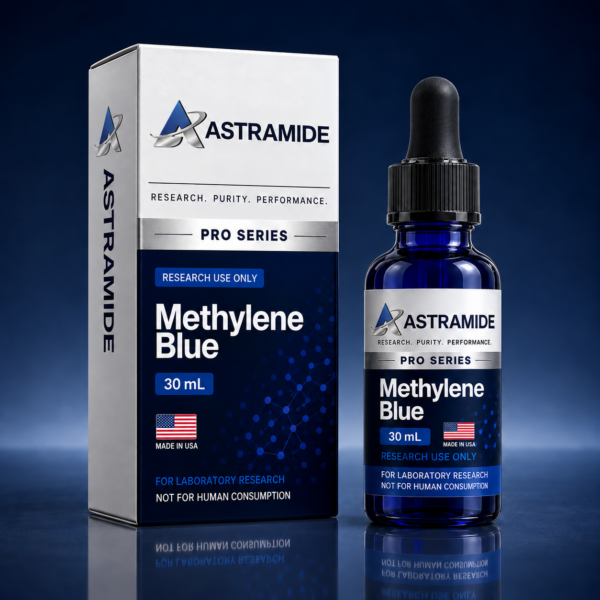
Methylene blue (methylthioninium chloride) is a small-molecule phenothiazinium dye, 3,7-bis(dimethylamino)phenothiazin-5-ium chloride. Its formula is C16H18ClN3S, its molecular weight is about 319.9 g/mol and its CAS number is 61-73-4 (PubChem CID 6099). Methylene Blue Pro is supplied as a 10 mg/mL solution in a 30 mL bottle. Sold for research use only.
Is methylene blue a peptide?
No. Methylene blue is a synthetic small-molecule dye with a tricyclic aromatic core, not a chain of amino acids, so it has no amino acid sequence. It is listed in the Pro Series because each lot is released under its own certificate with the same 99% HPLC purity criterion applied to the rest of the series.
What has methylene blue been examined for in published research?
Enzyme studies found that methylene blue inhibits nitric oxide synthase (Mayer et al., 1993, PMID 7679577) and inactivates guanylate cyclase through hydroxyl radical generation (Kontos and Wei, 1993, PMID 8095358). It is a reversible MAO-A inhibitor in kinetic studies (Ramsay et al., 2007, PMID 17721552). Astramide makes no claim about outcomes in humans.
What purity does the current Methylene Blue Pro lot reach?
Lot 202609MB_30L and 60L returned 99.88% purity by HPLC-DAD, reported by Hyte Research Division on 8 October 2026 under certificate AST#00001. Identity conformed to a methylene blue reference standard. The lot meets the Pro Series release criterion of at or above 99% HPLC purity. The full certificate is published on this page.
What concentration does the 30 mL solution measure?
Each 30 mL bottle carries a label claim of 10 mg/mL. For lot 202609MB_30L and 60L, the laboratory measured 11.11 mg/mL by HPLC-DAD, which is 111.1% of the label claim and above the certificate criterion of at least 90%. Astramide publishes the measured figure exactly as the laboratory reports it, above or below the label.
How should methylene blue solution be stored for research use?
Keep the bottle tightly closed and protected from light. Methylene blue is a redox-active dye: reducing agents convert it to colorless leucomethylene blue, and light exposure can promote photochemical change. Avoid contamination and repeated opening in non-clean conditions, because both can affect the comparability of experimental results.
How is Astramide's Methylene Blue Pro tested?
Lot 202609MB_30L and 60L was tested by Hyte Research Division, an independent analytical laboratory. The certificate reports identity, purity and concentration by HPLC-DAD, and it can be verified on the laboratory’s site with code 89W7-2R68-XKPK. Endotoxin, sterility and heavy metals are not reported on this certificate. Results apply only to this lot.
What does Pro Series mean for Methylene Blue Pro?
Methylene Blue Pro is part of the Astramide Pro Series. It is American-made, synthesized in the USA, and moves by domestic ground and air only, with no ocean freight. It is released under its own lot, and only when HPLC purity measures at or above 99%. The full certificate for each lot is published on this page.
This product is intended strictly for in-vitro laboratory research conducted by qualified professionals. It is not intended for human or animal consumption, clinical use, or therapeutic application. The statements on this page have not been reviewed by the FDA. These research peptides are not intended to diagnose, treat, cure, or prevent any disease. Research Use Only.
Related products
-
 Pro Series
Sermorelin – Pro
Price range: $74.99 through $700.00Select options This product has multiple variants. The options may be chosen on the product page -
 Pro Series
Ipamorelin Pro
Price range: $55.00 through $619.00Select options This product has multiple variants. The options may be chosen on the product page -
 Pro Series
PT-141 – Pro
Price range: $50.00 through $450.00Select options This product has multiple variants. The options may be chosen on the product page -
 Pro Series
DSIP – Pro
Price range: $35.00 through $320.00Select options This product has multiple variants. The options may be chosen on the product page