Lot Black Cap · 2 mg vial · Krause Analytical · reported 2 March 2026 . The bar shows where the reported result falls against Astramide’s published release criterion. The notch marks the criterion.
Within criterionAbove criterionNot on this COA
Test
Method
Criterion
Result
Result vs criterion
Status
Identity
HPLC-UV-MS
Mass spectral match to the labelled compound
Confirmed
WITHIN SPEC
Chromatographic purity
HPLC-UV/MS
at or above 98.0%
>99.9 %
95at or above 98.0%100
WITHIN SPEC
Net content
HPLC-UV-MS
1.83 mg
80120
REPORTED
Endotoxin
LAL, USP <85>
below 0.5 EU/mL
<0.5 EU/mL
WITHIN SPEC
Values are reported per vial or bottle unless otherwise noted. Every figure here is taken from the batch Certificate of Analysis and nothing else.
Certificate of Analysis
TB-500 · Lot Black Cap · 2 mg vial · Lab No. 200511
Thymosin beta-4 is a 43-amino-acid linear peptide with an acetylated N-terminal serine. It belongs to the beta-thymosin family of small, highly charged actin-binding peptides and is largely unstructured in solution, adopting an extended conformation when bound to actin. The commercial name TB-500 is used here for synthetic full-length thymosin beta-4.
Thymosin beta-4 was isolated from thymus tissue, and its complete 43-residue sequence with an acetylated N-terminus was reported in 1981 (Low et al., 1981).
Biochemical studies later showed that thymosin beta-4 and its relative thymosin beta-10 both bind and sequester actin monomers, holding them in an unpolymerized pool (Yu et al., 1993).
A crystal structure of an actin complex with a thymosin beta-4 construct showed how the peptide stretches across the actin monomer and contacts both its ends, explaining how it blocks polymerization (Irobi et al., 2004). These studies place thymosin beta-4 in cytoskeletal and structural biology research.
These are published research systems. They do not describe approved clinical applications, and they do not establish efficacy or safety in humans.
Cited literature
Low TL et al., 1981. Complete amino acid sequence of bovine thymosin beta 4: a thymic hormone that induces terminal deoxynucleotidyl transferase activity in thymocyte populations. Proc Natl Acad Sci U S A. PMID 6940133. https://pubmed.ncbi.nlm.nih.gov/6940133/
Yu FX et al., 1993. Thymosin beta 10 and thymosin beta 4 are both actin monomer sequestering proteins. J Biol Chem. PMID 8416954. https://pubmed.ncbi.nlm.nih.gov/8416954/
Irobi E et al., 2004. Structural basis of actin sequestration by thymosin-beta4: implications for WH2 proteins. EMBO J. PMID 15329672. https://pubmed.ncbi.nlm.nih.gov/15329672/
Evidence level
Actin binding and sequestration by thymosin beta-4 are well characterised in biochemical and structural studies. Statements on this page describe experimental systems, not outcomes in humans.
Handling and storage
As supplied
Lyophilized powder in a sealed vial. Held in laboratory-rated freezers from arrival to shipment.
Storage
Store per the conditions printed on the vial label. Avoid heat, moisture and repeated temperature cycling.
Handling
For qualified professionals in controlled laboratory environments, following validated laboratory procedures.
Frequently asked questions
About this compound and its batch data.
What purity did this thymosin beta-4 batch achieve?
This lot was analysed by Krause Analytical and returned chromatographic purity above 99.9% by HPLC with UV detection coupled to mass spectrometry. Identity was confirmed by mass spectral match. The full certificate is published on this page, and every figure shown here is taken from it.
How much peptide is in the vial?
The laboratory measured 1.83 mg against a 2 mg label claim, which is 91.6% of label. Net content is reported on a per-vial basis. Astramide publishes the measured figure rather than the label claim, whether it falls above or below.
Was this batch tested for endotoxins?
Yes. Endotoxin testing was performed using the Limulus Amebocyte Lysate assay in accordance with USP <85>, and this batch returned <0.5 EU/mL. The result appears on the certificate published on this page.
How should this material be stored for research use?
As supplied, the lyophilized powder should be held at -20°C and protected from light and moisture. Once reconstituted, store at 2-8°C and use within 14 to 30 days. Avoid repeated freeze-thaw cycles and follow the handling procedures appropriate to your laboratory.
What is the difference between research-grade and pharmaceutical-grade thymosin beta-4?
These are separate classifications. Research-grade material is supplied for laboratory research use only and is not intended for human or animal consumption. Pharmaceutical-grade is an FDA classification that applies to drugs manufactured for human use. Astramide supplies research-grade material only.
Why does this certificate show no lot number?
The laboratory issued this certificate with the Batch/Lot field left blank. Astramide identifies the lot by its black vial cap, lot Black Cap. The certificate can still be verified against Krause Analytical laboratory reference 200511.
Research use only
This product is intended strictly for in-vitro laboratory research conducted by qualified professionals.
It is not intended for human or animal consumption, clinical use, or therapeutic application.
The statements on this page have not been reviewed by the FDA. These research peptides are not intended
to diagnose, treat, cure, or prevent any disease. Research Use Only.
Get It Now
This product has multiple variants. The options may be chosen on the product page
Added to your cart
Your cart is empty.
Your Privacy Choices
We use analytics and advertising tools to understand how visitors find us and which campaigns work. You can turn either off. Your choice is saved in this browser.
AnalyticsGoogle Analytics, Microsoft Clarity and order source tracking. Helps us see how the site is used and fix problems.
Off (browser signal)
AdvertisingMeta and X pixels, and server-side events. Opting out also opts you out of "sharing" and targeted advertising under state privacy laws.
Off (browser signal)
Your browser is sending a Global Privacy Control signal, so analytics and advertising are off. To change this, turn off the signal in your browser settings.
Strictly necessary cookies (cart, sign-in, checkout, entry acknowledgment) always stay on. See our Privacy Policy.
Know what's in it before you order.
Every Astramide batch is tested by an independent US lab. The report goes public before the batch goes on sale, so you can check the numbers first.
Independent US lab test on every batch
Full report published before it goes on sale
Kept frozen, shipped from Austin, Texas
GLP-3RLot 2026/02 · May 8, 2026
>99.9%purity by HPLC-UV/MS
90%Minimum 98.0%100%
Identity: Confirmed by mass specEndotoxin: Below 0.5 EU/mL

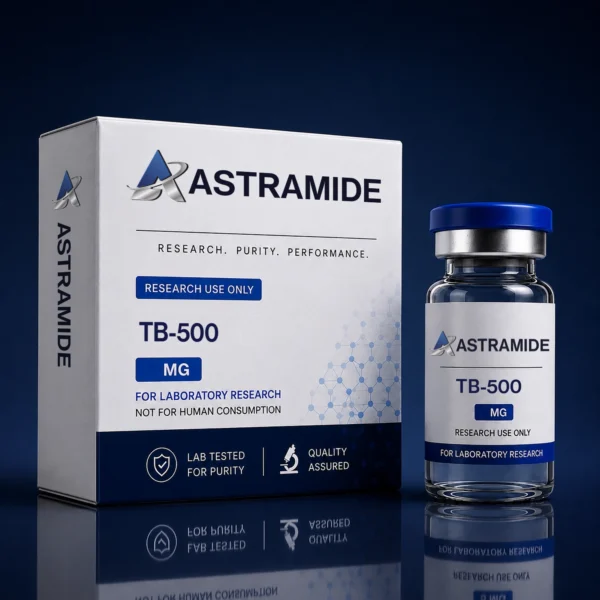

 Pro Series
 Pro Series