Lot 2026/02 · Krause Analytical · reported 19 May 2026 . The bar shows where the reported result falls against Astramide’s published release criterion. The notch marks the criterion.
Within criterionAbove criterionNot on this COA
Test
Method
Criterion
Result
Result vs criterion
Status
Identity
HPLC-UV-MS
Mass spectral match to the labelled compound
Confirmed
WITHIN SPEC
Chromatographic purity
HPLC-UV/MS
at or above 98.0%
99.5 %
95at or above 98.0%100
WITHIN SPEC
Net content — BPC-157
HPLC-UV-MS
10.1 mg
80120
REPORTED
Net content — GHK-Cu
HPLC-UV-MS
39.7 mg
80120
REPORTED
Net content — TB-500
HPLC-UV-MS
13.4 mg
80120
REPORTED
Endotoxin
LAL, USP <85>
below 0.5 EU/mL
<0.5 EU/mL
WITHIN SPEC
Values are reported per vial or bottle unless otherwise noted. Every figure here is taken from the batch Certificate of Analysis and nothing else.
No single shared target. Published research has examined GHK copper complexes in extracellular matrix studies, actin monomer binding by thymosin beta-4, and BPC-157 in a range of pre-clinical models.
Physical form
Lyophilized powder
GLOW is a lyophilized blend of three research peptides in one vial: GHK-Cu (50 mg), BPC-157 (10 mg) and TB-500 (10 mg), 70 mg in total. GHK-Cu is the copper(II) complex of the tripeptide Gly-His-Lys (C14H24CuN6O4, about 403.9 g/mol). BPC-157 is a 15-amino-acid peptide (GEPPPGKPADDAGLV, C62H98N16O22, about 1419.5 g/mol). TB-500 is a thymosin beta-4 peptide. The blend is blue to violet because of the copper complex.
Research profile
Where GLOW (BPC-157 + GHK-Cu + TB-500) appears in the literature.
GLOW combines three peptides that have each been studied separately; no published study has examined the blend itself.
GHK is a naturally occurring tripeptide that binds copper(II), and the GHK-copper complex has been studied in extracellular matrix and tissue remodeling research (Pickart et al., 2008).
Thymosin beta-4 binds and sequesters actin monomers, holding them in an unpolymerized pool (Yu et al., 1993). BPC-157 is a 15-residue peptide that has been examined in a range of pre-clinical models, including nervous system research (Vukojevic et al., 2022).
These are published research systems. They do not describe approved clinical applications, and they do not establish efficacy or safety in humans.
Cited literature
Pickart L et al., 2008. The human tri-peptide GHK and tissue remodeling. J Biomater Sci Polym Ed. PMID 18644225. https://pubmed.ncbi.nlm.nih.gov/18644225/
Yu FX et al., 1993. Thymosin beta 10 and thymosin beta 4 are both actin monomer sequestering proteins. J Biol Chem. PMID 8416954. https://pubmed.ncbi.nlm.nih.gov/8416954/
Vukojevic J et al., 2022. Pentadecapeptide BPC 157 and the central nervous system. Neural Regen Res. PMID 34380875. https://pubmed.ncbi.nlm.nih.gov/34380875/
Evidence level
Each component has its own pre-clinical literature, but no published study has examined the three-component blend. Statements on this page describe experimental systems for the individual components, not outcomes in humans.
Handling and storage
As supplied
Lyophilized powder in a sealed vial. Held in laboratory-rated freezers from arrival to shipment.
Storage
Store per the conditions printed on the vial label. Avoid heat, moisture and repeated temperature cycling.
Handling
For qualified professionals in controlled laboratory environments, following validated laboratory procedures.
GLOW is a lyophilized research blend of three peptides in one vial: BPC-157 (10 mg), GHK-Cu (50 mg) and TB-500 (10 mg), 70 mg by label in total. The identity of each component is confirmed by mass spectrometry on the lot certificate. It is supplied for laboratory research use only.
What has GLOW been examined for in published research?
No published study has examined the three-component GLOW blend itself. Its components have been studied separately in pre-clinical work: BPC-157 (Vukojevic et al., 2022, PMID 34380875), GHK in tissue remodeling research (Pickart et al., 2008, PMID 18644225) and beta-thymosins (Hannappel, 2007, PMID 17468232). Astramide makes no claim about outcomes in humans.
What purity does the current GLOW lot reach?
Lot 2026/02 measured 99.5% chromatographic purity by HPLC-UV/MS, against a 98.0% specification. Identity of all three components was confirmed by mass spectral match. The lot was tested by Krause Analytical, laboratory reference 205074, reported 19 May 2026. Quote that reference to the laboratory to verify the certificate independently.
How much GLOW is in the vial?
Content is measured per component. Lot 2026/02: BPC-157 10.1 mg (101% of the 10 mg label), GHK-Cu 39.7 mg (79.4% of 50 mg) and TB-500 13.4 mg (134% of 10 mg). GHK-Cu is below label and TB-500 is above it. Astramide publishes the measured figures, not the label claim. Net content is a separate question from purity.
How is Astramide's GLOW tested?
Every lot is tested by an independent third-party laboratory. Lot 2026/02 was tested by Krause Analytical for identity and purity by HPLC-UV-MS, net content per component, and endotoxin by LAL to USP chapter 85, which returned below 0.5 EU/mL. Appearance is not reported on this certificate. Each method is explained in how Astramide tests every lot.
How should GLOW be stored for research use?
As supplied, the lyophilized powder should be held at -20°C and protected from light and moisture. Once reconstituted, store at 2 to 8°C and use within 14 to 30 days. Avoid repeated freeze-thaw cycles and follow the handling procedures appropriate to your laboratory.
What is the difference between research-grade and pharmaceutical-grade GLOW?
These are separate classifications. Research-grade material is supplied for laboratory research use only and is not intended for human or animal consumption. Pharmaceutical-grade is an FDA classification that applies to drugs manufactured for human use. Astramide supplies research-grade material only.
How is GLOW different from KLOW?
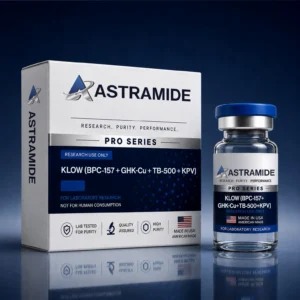
KLOW holds the same three peptides as GLOW, BPC-157 (10 mg), GHK-Cu (50 mg) and TB-500 (10 mg), plus 10 mg of KPV, for 80 mg by label. GLOW is 70 mg. Each blend is released under its own lot with its own certificate, so purity and content are reported separately for each.
Research use only
This product is intended strictly for in-vitro laboratory research conducted by qualified professionals.
It is not intended for human or animal consumption, clinical use, or therapeutic application.
The statements on this page have not been reviewed by the FDA. These research peptides are not intended
to diagnose, treat, cure, or prevent any disease. Research Use Only.
Get It Now
This product has multiple variants. The options may be chosen on the product page
Added to your cart
Your cart is empty.
Your Privacy Choices
We use analytics and advertising tools to understand how visitors find us and which campaigns work. You can turn either off. Your choice is saved in this browser.
AnalyticsGoogle Analytics, Microsoft Clarity and order source tracking. Helps us see how the site is used and fix problems.
Off (browser signal)
AdvertisingMeta and X pixels, and server-side events. Opting out also opts you out of "sharing" and targeted advertising under state privacy laws.
Off (browser signal)
Your browser is sending a Global Privacy Control signal, so analytics and advertising are off. To change this, turn off the signal in your browser settings.
Strictly necessary cookies (cart, sign-in, checkout, entry acknowledgment) always stay on. See our Privacy Policy.
Know what's in it before you order.
Every Astramide batch is tested by an independent US lab. The report goes public before the batch goes on sale, so you can check the numbers first.
Independent US lab test on every batch
Full report published before it goes on sale
Kept frozen, shipped from Austin, Texas
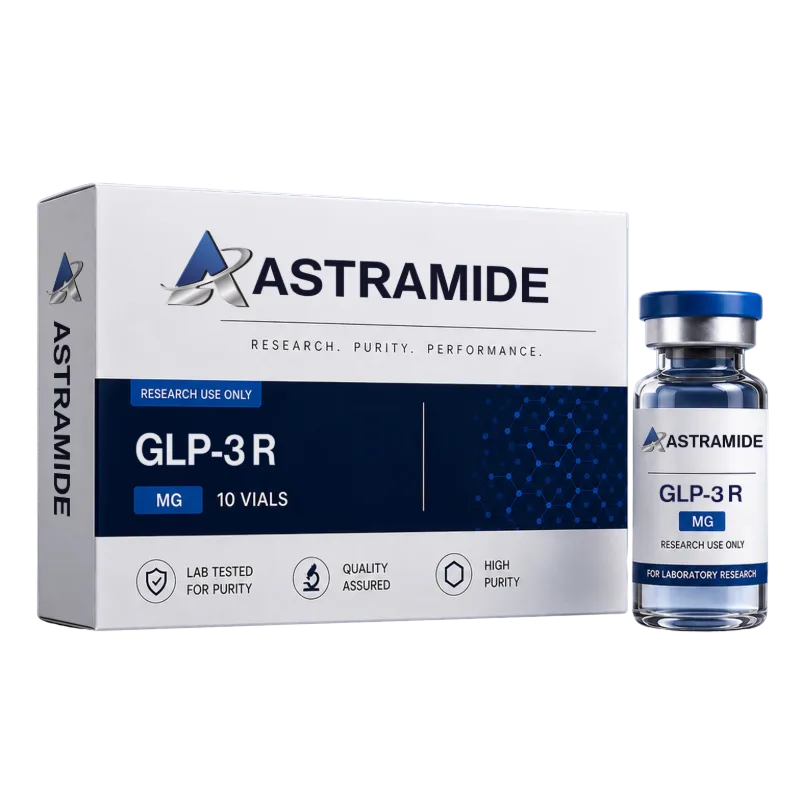
GLP-3RLot 2026/02 · May 8, 2026
>99.9%purity by HPLC-UV/MS
90%Minimum 98.0%100%
Identity: Confirmed by mass specEndotoxin: Below 0.5 EU/mL


 Pro Series
 Pro Series