Don't miss our holiday offer - up to 50% OFF!

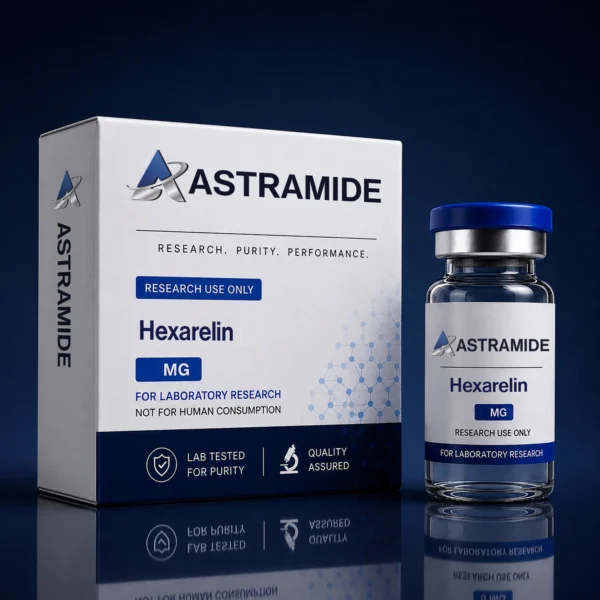
Hexarelin
Price range: $79.00 through $629.00
Batch Number: 2026/02
Purity Percentage: 99.6
Identity Confirmation: Krause Analytics
Testing Methods: HPLC-UV/MS
Credential Line: 205071
Test Date: 02/03/2026
Research Data
Research Classification
Growth Hormone Secretagogue / Ghrelin Receptor Agonist
Molecular Structure

Structure Description
Hexarelin is a synthetic six-residue growth hormone secretagogue with the sequence His-D-2-methyl-Trp-Ala-Trp-D-Phe-Lys-NH₂. The structure incorporates D-amino-acid residues and a 2-methyl-tryptophan substitution designed to produce a stable growth hormone-releasing peptide analog. Early pharmacological studies describe it as a potent GHRP-family secretagogue.
Research Discipline
Endocrinology; Peptide Biology; Ghrelin Receptor Research; Pituitary Biology; Hypothalamic Biology; Pharmacology; Cardiovascular Research
Molecular Formula
C₄₇H₅₈N₁₂O₆ This is the PubChem formula for Examorelin/Hexarelin.
Molecular Weight
Approximately 887.0 g/mol PubChem reports a monoisotopic molecular weight of approximately 886.46 Da for Examorelin.
CAS Number
140703-51-1 This CAS number is reported directly by Krause Analytical for the tested Hexarelin sample
Amino Acid Sequence
His-D-2-methyl-Trp-Ala-Trp-D-Phe-Lys-NH₂
Published human research describes Hexarelin using this six-residue sequence.
Primary Molecular Target
Growth Hormone Secretagogue Receptor (GHSR / GHS-R1a) Hexarelin belongs to the growth hormone secretagogue family and acts through specific GHS receptors at pituitary and hypothalamic sites. Additional research has examined peripheral Hexarelin-binding sites, including CD36-associated signaling in cardiovascular systems, but GHSR remains the primary endocrine target relevant to GH secretagogue research.
Experimental Applications
GHSR receptor signaling studies
Growth hormone release research
Pituitary signaling studies
Hypothalamic signaling research
Growth hormone secretagogue pharmacology
GH pulsatility research
Endocrine feedback studies
Ghrelin-receptor pathway studies
Cardiovascular experimental models
Peptide structure-function analysis
Experimental Systems
Published Hexarelin research systems include:
Human endocrine studies
Healthy adult volunteer studies
Pituitary-associated experimental systems
Hypothalamic signaling models
Peripheral lymphocyte models
Rat cardiovascular models
Myocardial infarction models
Endocrine tissue binding studies
GH secretion models
Human studies have directly evaluated Hexarelin-induced GH release and repeated secretagogue exposure.
Specific Assays
HPLC-UV chromatographic purity analysis
LC-MS identity confirmation
Mass-spectral analysis
Serum GH assays
Prolactin assays
ACTH assays
Cortisol assays
GH pulse analysis
Receptor-binding assays
GHSR expression analysis
Endocrine hormone profiling
USP <85> endotoxin testing
For the actual OPTMZ lot, Krause Analytical specifically performed HPLC-UV-MS analysis and USP <85> endotoxin testing.
Measured Endpoints
Chromatographic purity
Hexarelin identity
Hexarelin content
Endotoxin concentration
Growth hormone concentration
GH secretory pulse mass
Prolactin concentration
ACTH concentration
Cortisol concentration
GHSR-associated signaling
Endocrine tissue binding
Cardiovascular physiological responses
Published human experiments measured GH and other pituitary-adrenal hormones following Hexarelin exposure.
For the actual OPTMZ sample, the directly measured analytical endpoints were purity, identity, Hexarelin content, and endotoxin concentration.
Mechanism / Research Context
Hexarelin is a synthetic growth hormone secretagogue that stimulates growth hormone release through growth hormone secretagogue receptor-associated signaling at pituitary and hypothalamic sites.
Its mechanism differs from that of GHRH analogs. Rather than directly targeting the GHRH receptor, Hexarelin belongs to the GHS/ghrelin-receptor signaling class. Human and animal studies have demonstrated growth-hormone release following Hexarelin exposure.
Research has also demonstrated GHSR-1a expression changes in hypothalamic and pituitary tissues following Hexarelin exposure, further supporting its relevance to GHSR-associated endocrine signaling.
Separate preclinical studies have investigated cardiovascular effects and peripheral binding sites, including CD36-associated mechanisms. Those peripheral findings should be distinguished from Hexarelin's principal endocrine GHSR activity.
Evidence Level
Clinical Research Hexarelin has been evaluated in controlled human studies examining GH release, endocrine hormone responses, and repeated-administration effects, in addition to substantial preclinical research. This classification refers to the existence of human research and does not imply FDA approval or established therapeutic efficacy.
Research References
Imbimbo BP, et al. Growth hormone-releasing activity of hexarelin in humans. Human study characterizing the GH-releasing activity of Hexarelin and identifying its sequence as His-D-2-methyl-Trp-Ala-Trp-D-Phe-Lys-NH₂. PMID: 7957536. Arvat E, et al. Hexarelin, a synthetic growth-hormone releasing peptide: endocrine effects and mechanisms. Research examining pituitary and hypothalamic GHS activity. PMID: 9430449. Maccario M, et al. Research examining repeated Hexarelin administration and 24-hour GH, prolactin, ACTH, and cortisol secretion. PMID: 11888836. Papotti M, et al. Growth hormone secretagogue binding sites in peripheral human tissues. Research evaluating Hexarelin-related binding outside classical endocrine systems. PMID: 11061542. Bresciani E, et al. Hexarelin modulates the expression of growth hormone secretagogue receptor type 1a mRNA at hypothalamic and pituitary sites. PMID: 15361691. PubChem CID 6918297: Examorelin molecular formula and structural information.
Analytical Characterization
Independent analytical testing of OPTMZ Peptides Hexarelin Acetate 10 mg, batch/lot 2026/02, by Krause Analytical reported:
Chromatographic Purity: 99.6%
Hexarelin Content: 9.5 mg
Label Claim: 10 mg
Percent of Label: 95.4%
Identity: Hexarelin (Examorelin) confirmed
CAS Number: 140703-51-1
Analysis Method: HPLC-UV-MS
Endotoxins: <0.5 EU/mL
Endotoxin Method: USP <85>
Lab Number: 205071
Project: 145211
Date Received: April 28, 2026
Report Issued: May 22, 2026
The laboratory states that analytical values are reported on a per-vial basis unless otherwise noted.
The report also provides the underlying chromatographic data on page 2 and mass-spectral data on page 3.
Research Keywords
Imbimbo BP, et al. Growth hormone-releasing activity of hexarelin in humans. Human study characterizing the GH-releasing activity of Hexarelin and identifying its sequence as His-D-2-methyl-Trp-Ala-Trp-D-Phe-Lys-NH₂. PMID: 7957536.
Arvat E, et al. Hexarelin, a synthetic growth-hormone releasing peptide: endocrine effects and mechanisms. Research examining pituitary and hypothalamic GHS activity. PMID: 9430449.
Maccario M, et al. Research examining repeated Hexarelin administration and 24-hour GH, prolactin, ACTH, and cortisol secretion. PMID: 11888836.
Papotti M, et al. Growth hormone secretagogue binding sites in peripheral human tissues. Research evaluating Hexarelin-related binding outside classical endocrine systems. PMID: 11061542.
Bresciani E, et al. Hexarelin modulates the expression of growth hormone secretagogue receptor type 1a mRNA at hypothalamic and pituitary sites. PMID: 15361691.
PubChem CID 6918297: Examorelin molecular formula and structural information.
Extra Features
- Premium Quality
- Secure Payments
- Satisfaction Guarantee
- Worldwide Shipping
- Money Back Guarantee
| Pcs | Single Vial, Pack Of 10 |
|---|---|
| Strength | 10mg |
Reviews
There are no reviews yet.