GHRP-2 is a synthetic six-residue growth hormone secretagogue incorporating several non-natural amino-acid residues. Its sequence is D-Ala-D-2-Nal-Ala-Trp-D-Phe-Lys-NH₂, including D-alanine, D-2-naphthylalanine, and D-phenylalanine residues. These structural modifications distinguish GHRP-2 from endogenous peptide hormones and contribute to its utility as an experimental GHSR agonist.
158861-67-7 PubChem substance records associate this CAS number with GHRP-2 / Pralmorelin.
Amino Acid Sequence
158861-67-7
PubChem substance records associate this CAS number with GHRP-2 / Pralmorelin.
Primary Molecular Target
Growth Hormone Secretagogue Receptor (GHSR / GHS-R1a), also known as the ghrelin receptor GHRP-2 is described in published human research as a synthetic ghrelin agonist acting through the growth hormone secretagogue receptor.
Experimental Applications
GHSR receptor signaling studies
Growth hormone secretion research
Pituitary somatotroph research
Ghrelin-receptor pharmacology
Appetite and food-intake research
Endocrine signaling studies
Gastrointestinal physiology research
GH secretagogue comparisons
Peptide structure-function research
Growth hormone pathway analysis
Experimental Systems
Rat pituitary-cell cultures
Pituitary somatotroph systems
Human endocrine studies
Human food-intake studies
Ghrelin-receptor signaling models
Gastrointestinal physiology models
Growth hormone response models
Experimental systems with altered GHRH receptor signaling
Human studies have examined both GH release and food-intake responses to GHRP-2.
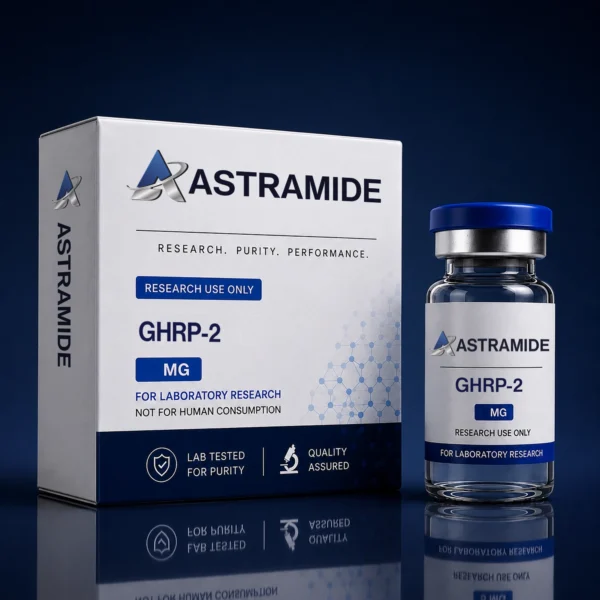
For the actual OPTMZ product, the directly measured analytical endpoints were purity, identity, GHRP-2 content, appearance, and endotoxin assay performance.
Mechanism / Research Context
GHRP-2 is a synthetic growth hormone secretagogue that acts through the growth hormone secretagogue receptor, also known as the ghrelin receptor.
Activation of GHSR is associated with pituitary growth-hormone release and additional ghrelin-related signaling pathways. GHRP-2 has been shown experimentally to stimulate GH release through the same receptor class used by other synthetic growth hormone-releasing peptides, while its mechanism remains distinct from direct GHRH receptor stimulation.
Human research has also demonstrated that GHRP-2 can increase food intake while producing a significant GH response, making it an experimental tool for studying both endocrine and ghrelin-associated feeding pathways.
Evidence Level
Clinical Research GHRP-2 has been evaluated in controlled human studies in addition to substantial preclinical research. Human investigations have examined GH secretion, appetite, and food intake. This classification refers to the existence of human research and does not imply FDA approval or established therapeutic efficacy.
Research References
Laferrère B, et al. Growth hormone-releasing peptide-2 (GHRP-2), like ghrelin, increases food intake in healthy men. J Clin Endocrinol Metab. 2005. PMID: 15699539. Cheng K, et al. Growth hormone releasing peptides: a comparison of the mechanism of action of GHRP-6 and GHRP-2. Endocrinology. 1997. PMID: 9096259. Peroni CN, et al. Research examining direct GHRP-2 action in pituitary somatotroph cells with inactive GHRH receptors. PubChem CID 6918245: Pralmorelin molecular formula, molecular weight, and compound identity.
Analytical Characterization
Independent analytical testing of OPTMZ Peptides GHRP-2 5 mg, lot G25, by Freedom Diagnostics reported:
Purity (HPLC-UV): 99.52%
Identity (LC-MS): GHRP-2 confirmed
Measured Net Content: 5.39 mg
Label Claim: 5 mg
Appearance: White lyophilized powder
Endotoxin Replicate 1: Pass
Endotoxin Replicate 2: Pass
Assay Sensitivity: ≤0.05 EU/mL
Analytical Method: HPLC with UV detection coupled with LC-MS
Endotoxin Method: Limulus Amebocyte Lysate assay in accordance with USP <85>
Accession #: 2606080462
Date Received: June 8, 2026
Report Issued: June 9, 2026
These results come directly from the Freedom Diagnostics Certificate of Analysis for the submitted lot.
The lot-specific purity, identity, net content, appearance, and endotoxin results above come directly from the Freedom Diagnostics COA.
PubChem identifies GHRP-2 as Pralmorelin, with molecular formula C₄₅H₅₅N₉O₆ and molecular weight 818.0 g/mol.
Analytical & Testing
Each tested batch of GHRP-2 undergoes analytical evaluation to verify purity, identity, peptide content, and analytical consistency.
For the submitted OPTMZ Peptides sample, Freedom Diagnostics reported:
Identity (LC-MS): GHRP-2 — Confirmed
Purity (HPLC-UV): 99.52%
Measured Net Content: 5.39 mg
Label Claim: 5 mg
Appearance: White lyophilized powder
Endotoxin Replicate 1: Pass
Endotoxin Replicate 2: Pass
Assay Sensitivity: ≤0.05 EU/mL
Lot: G25
Accession #: 2606080462
The laboratory reports HPLC with UV detection coupled with mass spectrometry and states that endotoxin testing was performed using the Limulus Amebocyte Lysate assay in accordance with USP <85>.
The same single-page COA also contains the chromatogram and mass-confirmation spectrum supporting the reported identity analysis.
Handling & Storage
GHRP-2 should be handled by qualified professionals in controlled laboratory environments. Appropriate storage conditions should be maintained to preserve peptide stability and structural integrity.
Avoid unnecessary exposure to heat, moisture, light, and repeated temperature fluctuations. Experimental preparation, storage, and handling should follow validated laboratory procedures appropriate to the intended research application.
Research Context
GHRP-2 is investigated primarily in experimental and clinical research involving growth hormone secretagogue receptor signaling and pituitary growth-hormone release.
Research areas include:
GHSR / ghrelin receptor signaling
Growth hormone secretion
Pituitary somatotroph biology
GH secretagogue pharmacology
Ghrelin-mimetic research
Appetite and food-intake models
Endocrine signaling
Gastrointestinal physiology
Peptide structure-function studies
Comparative growth-hormone secretagogue research
GHRP-2 is a synthetic agonist of the ghrelin receptor and has been extensively studied as a growth hormone secretagogue. Human research has also examined its effects on food intake and circulating GH.
Experimental pituitary-cell research has shown that GHRP-2 can stimulate GH release through a mechanism distinct from direct GHRH receptor activation.
These findings describe experimental and clinical research observations and do not establish approved therapeutic use of the research material supplied here.
Research Application Scope
GHRP-2 is relevant to controlled investigations involving ghrelin-receptor biology, pituitary signaling, growth-hormone secretion, appetite-associated pathways, endocrine pharmacology, and synthetic peptide structure-function relationships.
Because GHRP-2 acts primarily through GHSR, it is mechanistically distinct from GHRH analogs such as Tesamorelin and CJC-1295, which act through the GHRH receptor.
Use Statement
For laboratory research use only. Intended strictly for in vitro and controlled experimental research applications.
Disclaimer
All products currently listed on this site are for research purposes ONLY.



Reviews
There are no reviews yet.