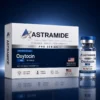
| Pcs | Single Vial, Pack of 10 |
|---|---|
| Strength | 10mg |
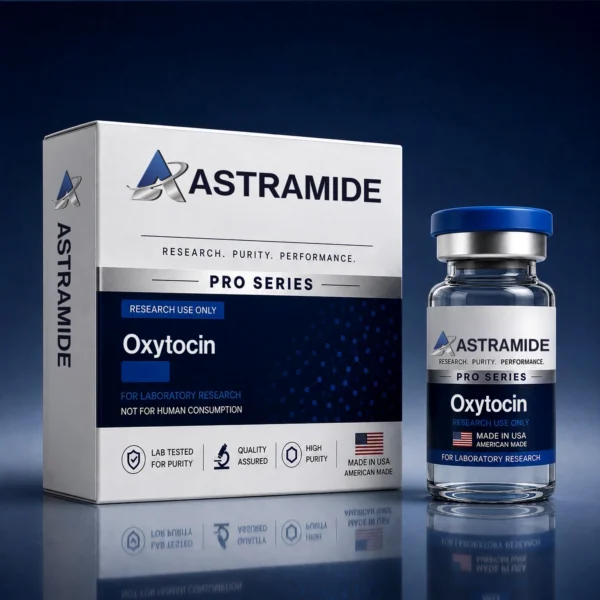
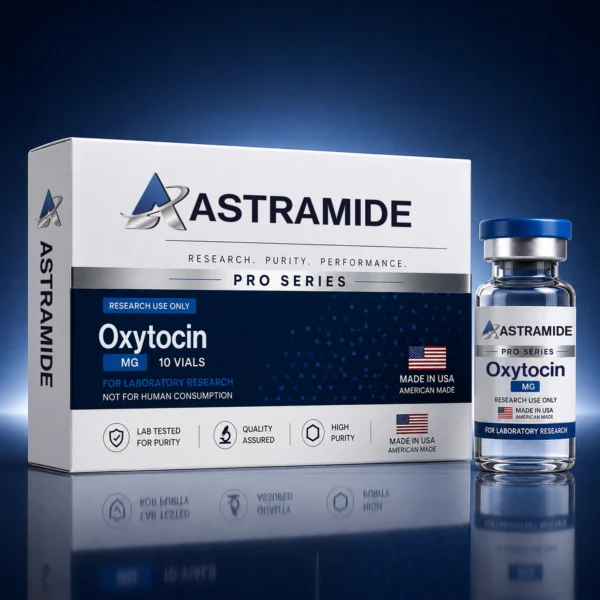
Oxytocin Acetate – Pro
Pro Series
Oxytocin, a cyclic nonapeptide hormone, supplied as the acetate salt
CAS 50-56-6C₄₃H₆₆N₁₂O₁₂S₂Approximately 1007.2 g/mol9 amino acidsCyclic peptideLyophilized powder
Price range: $60.00 through $550.00
Why the Pro Series costs more
- Synthesized in the USA. Domestic ground and air only, no ocean freight.
- Released only above 99% HPLC purity.
- Its own lot and its own published certificate.
Ships from Austin, TexasUnited States only
Tested by an outside labNever in-house
Every lot publishedIncluding rejected lots
Same-day dispatchOn orders before 2pm ET
BATCH
VERIFICATION
VERIFICATION
LOT NUMBER
PLB-OXY10-20260821-01
10 mg vial
IDENTITY
Supported by HPLC retention-time match to a certified reference standard (no mass spectrometry on this certificate)
CHROMATOGRAPHIC PURITY
99%
MICROBIAL PANEL
Pass, 6 organisms not detected in 1 g
Quick reference
How to read this report
Same six keys on every Astramide product page. Only the values change.
1Lot numberMatch it to the number printed on your vial. If they differ, this report is not for your vial.
2IdentityMass spectrometry confirms the molecule is the one on the label. It conforms or it does not. There is no partial result.
3Chromatographic purityThe share of the material that is the target peptide. A purity figure quoted without a method is not a purity figure.
4Net contentHow much peptide is in the vial, as measured by the laboratory. A different question from purity.
5EndotoxinMeasured against a ceiling, not a floor. Sensitivity differs by laboratory, so results are not compared across labs.
6Laboratory, method, dateWho ran it, on what instrument, and when. A report with no named laboratory or no date is not a report.
Molecular profile
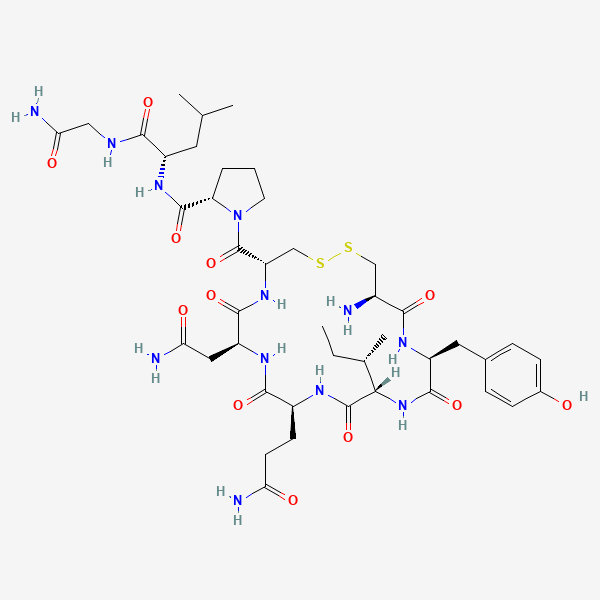
Oxytocin Acetate - Pro, in structural terms.
- Sequence
- Cys-Tyr-Ile-Gln-Asn-Cys-Pro-Leu-Gly-NH2 (CYIQNCPLG-NH2), disulfide bridge Cys1-Cys6
- Molecular formula
- C₄₃H₆₆N₁₂O₁₂S₂
- Molecular weight
- Approximately 1007.2 g/mol
- CAS number
- 50-56-6
- Peptide length
- 9 amino acids
- Structure type
- Cyclic peptide
- Parent sequence
- Oxytocin-neurophysin I precursor (OXT gene)
- Primary molecular target
- Oxytocin receptor (OXTR), a class A G protein-coupled receptor that couples mainly to Gq/11, phospholipase C and release of intracellular calcium.
- Physical form
- Lyophilized powder
- PubChem CID
- 439302
Oxytocin is a nine-amino-acid peptide (Cys-Tyr-Ile-Gln-Asn-Cys-Pro-Leu-Gly-NH2) with a disulfide bridge between Cys1 and Cys6, which closes a six-residue ring, followed by a three-residue tail ending in glycinamide. It belongs to the oxytocin and vasopressin family of neurohypophysial peptides. It is supplied here as the acetate salt (CAS 6233-83-6, C45H70N12O14S2, about 1067.2 g/mol); the formula, weight and CAS fields on this page describe the peptide itself.
Research profile
Where Oxytocin Acetate - Pro appears in the literature.
Neuroendocrinology; Receptor Pharmacology; GPCR Signaling; Structural Biology; Peptide Chemistry
Research applications
- Published studies have used oxytocin in:
- OXTR cloning, expression and binding studies
- Gq/11, phospholipase C and calcium signaling studies
- Oxytocin and vasopressin receptor selectivity studies
- OXTR structural biology
Experimental systems
- Cell lines transfected with cloned human OXTR
- Membrane preparations for radioligand binding
- Purified oxytocin-OXTR-Gq complexes for cryo-electron microscopy
Specific assays
- Receptor cDNA cloning and expression
- Radioligand binding assays
- Intracellular calcium measurement
- Inositol phosphate accumulation assays
- Cryo-electron microscopy
Measured endpoints
- Binding affinity at OXTR
- Intracellular calcium mobilization
- Second-messenger accumulation
- Ligand-receptor contact residues and divalent cation dependence
Mechanism and research context
What has been studied, and in what systems.
Oxytocin is a cyclic nonapeptide whose principal molecular target is the oxytocin receptor. The human receptor was cloned in 1992 and identified as a seven-transmembrane G protein-coupled receptor; when expressed in cultured cells it bound oxytocin and produced intracellular calcium responses (Kimura et al., 1992).
A comprehensive review of the receptor system described its coupling to Gq/11 and phospholipase C, its regulation, and its dependence on divalent cations and membrane cholesterol for high-affinity binding (Gimpl and Fahrenholz, 2001).
A cryo-electron microscopy structure of oxytocin bound to its receptor and Gq later described the ligand binding pocket and a molecular switch linked to the receptor's cation dependence (Meyerowitz et al., 2022). These studies place oxytocin in receptor pharmacology and structural biology research.
These are published research systems. They do not describe approved clinical applications, and they do not establish efficacy or safety in humans.
Cited literature
Kimura T et al., 1992. Structure and expression of a human oxytocin receptor. Nature. PMID 1313946. https://pubmed.ncbi.nlm.nih.gov/1313946/
Gimpl G, Fahrenholz F, 2001. The oxytocin receptor system: structure, function, and regulation. Physiol Rev. PMID 11274341. https://pubmed.ncbi.nlm.nih.gov/11274341/
Meyerowitz JG et al., 2022. The oxytocin signaling complex reveals a molecular switch for cation dependence. Nat Struct Mol Biol. PMID 35241813. https://pubmed.ncbi.nlm.nih.gov/35241813/
Evidence level
Oxytocin receptor pharmacology is well characterised in cloning, binding, cell-signaling and structural studies. Statements on this page describe experimental systems, not outcomes in humans.
Handling and storage
As supplied
Lyophilized powder in a sealed vial. Held in laboratory-rated freezers from arrival to shipment.
Storage
Store per the conditions printed on the vial label. Avoid heat, moisture and repeated temperature cycling.
Handling
For qualified professionals in controlled laboratory environments, following validated laboratory procedures.
Frequently asked questions
About this compound and its batch data.
What is oxytocin acetate?
Oxytocin is a cyclic nine-amino-acid peptide (CYIQNCPLG-NH2) with a disulfide bridge between Cys1 and Cys6. The peptide has the formula C43H66N12O12S2, a molecular weight of about 1007.2 g/mol and CAS number 50-56-6; it is supplied here as the acetate salt. Oxytocin Acetate Pro comes as a lyophilized powder in a 10 mg vial. Sold for research use only.
What has oxytocin been examined for in published research?
Published studies have cloned the human oxytocin receptor and shown that, when expressed in cultured cells, it binds oxytocin and triggers intracellular calcium responses (Kimura et al., 1992, PMID 1313946). Structural work has resolved oxytocin bound to its receptor and Gq protein (Meyerowitz et al., 2022, PMID 35241813). This page describes laboratory research. Astramide makes no claim about outcomes in humans.
What purity does the current Oxytocin Acetate Pro lot reach?
Lot PLB-OXY10-20260821-01 returned 99% chromatographic purity by HPLC at 254 nm, reported by pH Solutions Lab on 31 August 2026 under certificate PLB-COA-OXY10-20260821-01. Identity is supported by HPLC retention-time match to a certified reference standard; this certificate does not include mass spectrometry. The full certificate is published on this page.
How much oxytocin is in the vial?
The label claim is 10 mg per vial, and the certificate lists a target fill of 10.00 mg per vial. A measured net content result was not reported on this certificate for lot PLB-OXY10-20260821-01, and the page shows that row as not reported rather than estimating a figure.
How should oxytocin be stored for research use?
Lyophilized oxytocin is stored at -20°C and protected from light. Once reconstituted, the solution is held at 2 to 8°C and used within 14 to 30 days. Repeated temperature cycling and exposure to moisture should be avoided, because both can affect peptide stability and the comparability of experimental results.
How is oxytocin related to vasopressin?
Oxytocin and arginine vasopressin are both cyclic nonapeptides with a Cys1-Cys6 disulfide ring and a C-terminal glycinamide. They differ at two positions: oxytocin has isoleucine at position 3 and leucine at position 8, where vasopressin has phenylalanine and arginine. Their receptors belong to one related GPCR family, which is why selectivity between them is studied (Gimpl and Fahrenholz, 2001, PMID 11274341).
How is Astramide's Oxytocin Acetate Pro tested?
Lot PLB-OXY10-20260821-01 was tested by pH Solutions Lab, an independent ISO/IEC 17025:2017 accredited laboratory (PJLA #84351). The certificate reports chromatographic purity by HPLC at 254 nm, a qPCR microbial panel of six organisms (all not detected) and water activity of 0.20 aw against a limit of 0.65 aw. Results apply only to this lot.
What is the difference between Oxytocin Acetate and Oxytocin Acetate Pro?
Oxytocin Acetate Pro is part of the Astramide Pro Series. It is American-made, synthesized in the USA, and moves by domestic ground and air only, with no ocean freight. It is released under its own lot, and only when HPLC purity measures at or above 99%. The full certificate for each lot is published on this page. The standard Oxytocin Acetate is released under separate lots with separate certificates.
Research use only
This product is intended strictly for in-vitro laboratory research conducted by qualified professionals. It is not intended for human or animal consumption, clinical use, or therapeutic application. The statements on this page have not been reviewed by the FDA. These research peptides are not intended to diagnose, treat, cure, or prevent any disease. Research Use Only.
COA library
Every lot we have tested
Search by batch number. Past lots stay published.
How we test
The analytical panel
What each method measures and the criterion each lot must meet.
Open Lab
Send us your peptides
Any vendor. Same lab. Your own Certificate of Analysis.
Ships from Austin, TexasUSPS or UPS, your choice
United States onlyFree shipping at $150 and over
Optional shipping insuranceAdded at checkout
Replacement or store creditOn approved claims. See refund policy.
Related products
-
 Pro Series
TB-500 – Pro
Price range: $60.00 through $850.00Select options This product has multiple variants. The options may be chosen on the product page -
 Pro Series
GLP-3R – Pro
Price range: $129.00 through $2,331.00Select options This product has multiple variants. The options may be chosen on the product page -
 Pro Series
BPC-157 Pro
Price range: $65.00 through $630.00Select options This product has multiple variants. The options may be chosen on the product page -
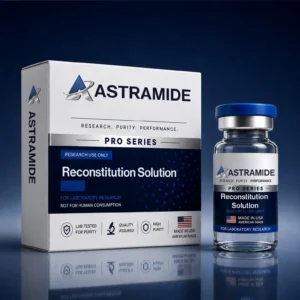 Pro Series
Reconstitution Solution Pro
Price range: $9.00 through $261.00Select options This product has multiple variants. The options may be chosen on the product page