Lot 202609Enclo_L · 12.5 mg/mL solution · Hyte Research Division · reported 12 October 2026 . The bar shows where the reported result falls against Astramide’s published release criterion. The notch marks the criterion.
Within criterionAbove criterionNot on this COA
Test
Method
Criterion
Result
Result vs criterion
Status
Identity
HPLC-DAD, against reference standard
Conforms to reference standard
Conforms to reference standard
WITHIN SPEC
Chromatographic purity
HPLC-DAD
at or above 99.0%
99.89%
95at or above 99.0%100
WITHIN SPEC
Concentration
HPLC-DAD
at or above 90% of label claim (11.25 mg/mL)
13.74 mg/mL (109.9% of 12.5 mg/mL label claim)
80at or above 90% of label claim (11.25 mg/mL)120
WITHIN SPEC
Appearance
Visual
clear liquid
Clear liquid
WITHIN SPEC
Endotoxin
LAL
—
Not reported on this certificate
NOT REPORTED
Microbial panel
—
Not reported on this certificate
NOT REPORTED
Heavy metals
—
Not reported on this certificate
NOT REPORTED
Residual solvents
—
Not reported on this certificate
NOT REPORTED
Sterility
—
Not reported on this certificate
NOT REPORTED
Values are reported per vial or bottle unless otherwise noted. Every figure here is taken from the batch Certificate of Analysis and nothing else.
Certificate of Analysis
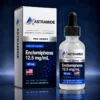
Enclomiphene Liquid - Pro · Lot 202609Enclo_L · 12.5 mg/mL solution · Lab No. AST#00006
Hyte Research Division · 2 pages · served inline, not a screenshot
Quick reference
How to read this report
Same six keys on every Astramide product page. Only the values change.
1Lot numberMatch it to the number printed on your product label. If they differ, this report is not for your product.
2IdentityMass spectrometry confirms the molecule is the one on the label. It conforms or it does not. There is no partial result.
3Chromatographic purityThe share of the material that is the target peptide. A purity figure quoted without a method is not a purity figure.
4Net contentHow much compound is in each vial or bottle, as measured by the laboratory. A different question from purity.
5EndotoxinMeasured against a ceiling, not a floor. Sensitivity differs by laboratory, so results are not compared across labs.
6Laboratory, method, dateWho ran it, on what instrument, and when. A report with no named laboratory or no date is not a report.
Molecular profile
Enclomiphene Liquid - Pro, in structural terms.
Sequence
Not applicable. Enclomiphene is a small molecule, not a peptide.
IUPAC name (free base): (2-{4-[(E)-2-chloro-1,2-diphenylethenyl]phenoxy}ethyl)diethylamine
Molecular formula
C₂₆H₂₈ClNO (free base)
Molecular weight
405.97 g/mol (free base)
CAS number
15690-57-0 (free base); 7599-79-3 (citrate salt)
Structure type
Reagent
Parent sequence
Clomiphene, trans (E) isomer
Primary molecular target
Estrogen receptor. Enclomiphene is studied as a selective estrogen receptor modulator. Depending on the tissue, species and concentration, published work has described estrogen antagonist or partial agonist activity (Huang and Miller, 1983; Jordan et al., 1981).
Physical form
Solution
Enclomiphene is the trans (E) geometric isomer of clomiphene, a triphenylethylene compound. Commercial clomiphene citrate is a mixture of two isomers: enclomiphene and the cis (Z) isomer, zuclomiphene. Enclomiphene is a small molecule, not a peptide. The free base has the molecular formula C26H28ClNO and a molecular weight of 405.97 g/mol, and it is commonly prepared as the citrate salt. This product is supplied as a clear solution at a nominal 12.5 mg/mL.
Research profile
Where Enclomiphene Liquid - Pro appears in the literature.
Enclomiphene is the trans isomer of clomiphene. Most published work compares it with the cis isomer, zuclomiphene, because the two isomers behave differently in experimental systems.
In cultured ovine pituitary cells, Huang and Miller (1983) reported that enclomiphene blocked the effect of estradiol, while zuclomiphene acted more like estradiol. They noted that rat pituitary cultures had given different results, and cautioned against assuming the same behaviour across species.
In the immature rat uterine weight test, Jordan et al. (1981) classed enclomiphene as partially estrogenic with antiestrogenic properties. Turner et al. (1998) compared the two isomers across several estrogen target tissues in ovariectomized rats.
Physical chemistry work has compared the amorphous solid forms of the two isomers (Trubert et al., 2025).
These studies describe cell, animal and chemical systems. They do not describe effects in people.
These are published research systems. They do not describe approved clinical applications, and they do not establish efficacy or safety in humans.
Cited literature
Huang ES and Miller WL, 1983. Estrogenic and antiestrogenic effects of enclomiphene and zuclomiphene on gonadotropin secretion by ovine pituitary cells in culture. Endocrinology. PMID 6401242. https://pubmed.ncbi.nlm.nih.gov/6401242/
Jordan VC et al., 1981. Geometric isomers of substituted triphenylethylenes and antiestrogen action. Endocrinology. PMID 6781873. https://pubmed.ncbi.nlm.nih.gov/6781873/
Turner RT et al., 1998. Differential responses of estrogen target tissues in rats including bone to clomiphene, enclomiphene, and zuclomiphene. Endocrinology. PMID 9724022. https://pubmed.ncbi.nlm.nih.gov/9724022/
Trubert J et al., 2025. Comparison between amorphous states of the trans/cis isomers of clomiphene: similarities and differences. Mol Pharm. PMID 41071236. https://pubmed.ncbi.nlm.nih.gov/41071236/
Evidence level
Preclinical and investigational. Enclomiphene is not approved by the FDA. Statements on this page describe published in vitro, animal and chemical studies only. They do not establish efficacy or safety in humans.
Handling and storage
As supplied
Solution in a sealed container, as stated on the product label.
Storage
Store per the conditions printed on the label. Keep tightly closed and protected from light and heat.
Handling
For qualified professionals in controlled laboratory environments, following validated laboratory procedures.
Frequently asked questions
About this compound and its batch data.
What is enclomiphene?
Enclomiphene is the trans (E) isomer of clomiphene, a triphenylethylene compound studied as a selective estrogen receptor modulator. It is a small molecule, not a peptide. The free base has the formula C26H28ClNO, a molecular weight of 405.97 g/mol and CAS number 15690-57-0. Astramide supplies it as a clear 12.5 mg/mL solution in a sealed bottle. Sold for research use only.
What has enclomiphene been examined for in published research?
Published research on enclomiphene is mostly preclinical. Huang and Miller (1983, Endocrinology, PMID 6401242) compared enclomiphene and zuclomiphene in cultured ovine pituitary cells and reported estrogen antagonist activity for enclomiphene. Jordan et al. (1981, PMID 6781873) classed it as partially estrogenic in an immature rat uterine assay. Astramide makes no claim about outcomes in humans.
What purity does the current Enclomiphene Liquid Pro lot reach?
The current lot is 202609Enclo_L. HPLC-DAD analysis by Hyte Research Division measured chromatographic purity of 99.89%, and identity conformed to a reference standard. The results are on report AST#00006, reported October 12, 2026. The full certificate is published with the lot record, which can be looked up by the lot number printed on the bottle.
What concentration is in the bottle?
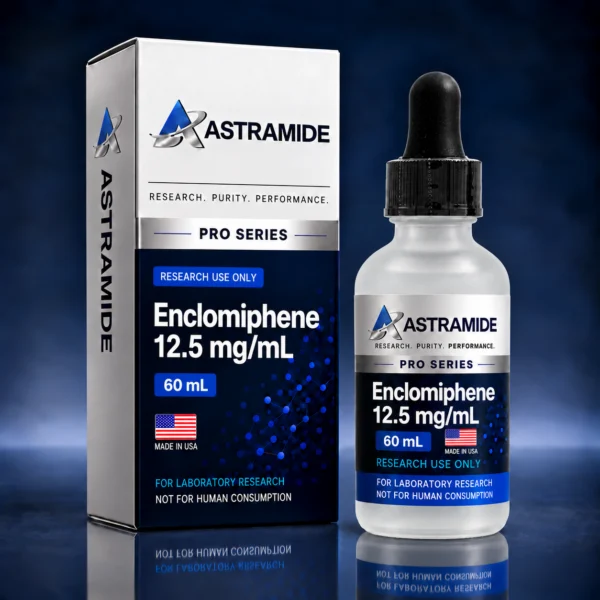
The label claim is 12.5 mg/mL. For lot 202609Enclo_L, Hyte Research Division measured 13.74 mg/mL, which is 109.9% of the label claim. The laboratory specification is not less than 90% of label claim (11.25 mg/mL). The figure is published exactly as the laboratory reported it. Enclomiphene Liquid Pro is sold in 30 mL and 60 mL bottles.
How was this lot tested?
This lot was tested by Hyte Research Division, an independent laboratory. The certificate covers purity, identity and quantity by HPLC-DAD, with identity checked against a reference standard. Mass spectrometry, endotoxin, microbial testing, heavy metals, residual solvents and sterility were not part of this certificate. Every reported result is published with the lot record.
How should Enclomiphene Liquid Pro be stored?
Keep the bottle sealed, upright and protected from light, at the storage temperature printed on the bottle label. Avoid heat and repeated temperature cycling. Once the seal is pierced, handle the solution with clean laboratory technique to avoid contamination. Handle only in a controlled laboratory setting by qualified professionals.
Is enclomiphene the same as clomiphene?
No. Clomiphene citrate is a mixture of two geometric isomers: enclomiphene, the trans (E) isomer, and zuclomiphene, the cis (Z) isomer. Published studies report that the two isomers behave differently in experimental systems. Enclomiphene Liquid Pro contains the enclomiphene isomer, not the clomiphene mixture.
What does Pro Series mean?
Enclomiphene Liquid Pro is part of the Astramide Pro Series. It is made in the USA, released under its own lot, and released only when HPLC purity measures at or above 99%. The current lot measured 99.89%. The certificate for each lot is published with its lot record.
Research use only
This product is intended strictly for in-vitro laboratory research conducted by qualified professionals.
It is not intended for human or animal consumption, clinical use, or therapeutic application.
The statements on this page have not been reviewed by the FDA. These research peptides are not intended
to diagnose, treat, cure, or prevent any disease. Research Use Only.
Get It Now
This product has multiple variants. The options may be chosen on the product page
Added to your cart
Your cart is empty.
Your Privacy Choices
We use analytics and advertising tools to understand how visitors find us and which campaigns work. You can turn either off. Your choice is saved in this browser.
AnalyticsGoogle Analytics, Microsoft Clarity and order source tracking. Helps us see how the site is used and fix problems.
Off (browser signal)
AdvertisingMeta and X pixels, and server-side events. Opting out also opts you out of "sharing" and targeted advertising under state privacy laws.
Off (browser signal)
Your browser is sending a Global Privacy Control signal, so analytics and advertising are off. To change this, turn off the signal in your browser settings.
Strictly necessary cookies (cart, sign-in, checkout, entry acknowledgment) always stay on. See our Privacy Policy.
Know what's in it before you order.
Every Astramide batch is tested by an independent US lab. The report goes public before the batch goes on sale, so you can check the numbers first.
Independent US lab test on every batch
Full report published before it goes on sale
Kept frozen, shipped from Austin, Texas
GLP-3RLot 2026/02 · May 8, 2026
>99.9%purity by HPLC-UV/MS
90%Minimum 98.0%100%
Identity: Confirmed by mass specEndotoxin: Below 0.5 EU/mL

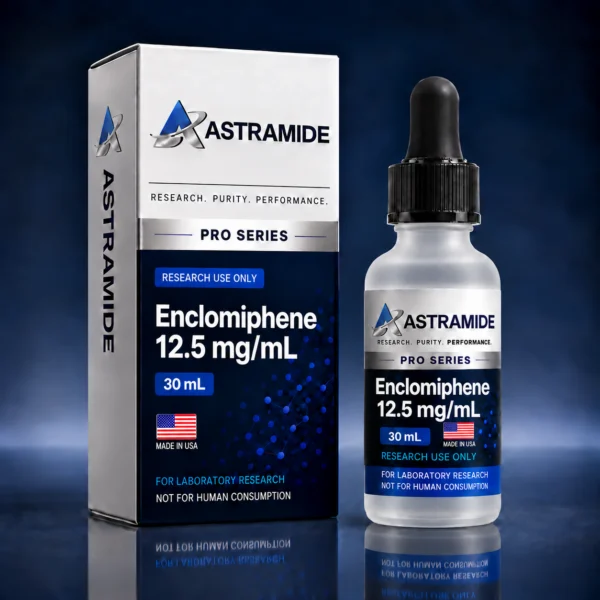
 Pro Series
 Pro Series
 Pro Series