Lot NHS-MOT-20260817-09 · 10 mg vial · pH Solutions Lab · reported 29 September 2026 . The bar shows where the reported result falls against Astramide’s published release criterion. The notch marks the criterion.
Within criterionAbove criterionNot on this COA
Test
Method
Criterion
Result
Result vs criterion
Status
Identity
Match to the labelled compound
Match (C101H152N28O22S2, 2174.6 g/mol)
WITHIN SPEC
Chromatographic purity
HPLC (274 nm)
at or above 99.0%
99%
95at or above 99.0%100
WITHIN SPEC
Net content
9.9184 mg (99.184% of 10 mg label claim)
80120
REPORTED
Appearance
Visual
white lyophilized powder
White to off-white lyophilized powder cake, free of visible particulates
WITHIN SPEC
Water content
Karl Fischer
reported
1.684%
WITHIN SPEC
pH
reported
7.0
WITHIN SPEC
Water activity
within laboratory limit
0.2445 aw, pass
WITHIN SPEC
Microbial panel
not detected
Pass, 10 organisms and counts not detected in 1 g
WITHIN SPEC
Heavy metals
within laboratory limits
Pass. As, Cd, Pb, Hg each 0.000 ppm
WITHIN SPEC
Residual solvents
within laboratory limits
Pass, 12 solvents each 0.000 ppm
WITHIN SPEC
Sterility
sterile
Pass
WITHIN SPEC
Mycotoxins
within laboratory limits
Pass
WITHIN SPEC
Endotoxin
LAL
—
Not reported on this certificate
NOT REPORTED
Values are reported per vial unless otherwise noted. Every figure here is taken from the batch Certificate of Analysis and nothing else.
Certificate of Analysis
MOTS-c - Pro · Lot NHS-MOT-20260817-09 · 10 mg vial · Lab No. NHS-MOT-20260817-09
Short open reading frame within the mitochondrial 12S rRNA gene (MT-RNR1)
Primary molecular target
No single cell-surface receptor has been identified for MOTS-c. Published studies link it to inhibition of the folate cycle and de novo purine synthesis, with AICAR accumulation and AMPK activation, and to AMPK-dependent translocation to the nucleus under metabolic stress.
MOTS-c is a linear 16-amino-acid peptide (Met-Arg-Trp-Gln-Glu-Met-Gly-Tyr-Ile-Phe-Tyr-Pro-Arg-Lys-Leu-Arg) encoded by a short open reading frame within the mitochondrial 12S rRNA gene, MT-RNR1. It belongs to the mitochondrial-derived peptide family. The sequence contains two methionine residues, aromatic tryptophan, tyrosine and phenylalanine residues, and a basic C-terminal Arg-Lys-Leu-Arg segment.
MOTS-c is a 16-amino-acid peptide encoded within the mitochondrial genome rather than the nuclear genome. Its discovery study reported that it inhibited the folate cycle and the linked de novo purine synthesis pathway, which led to AICAR accumulation and AMPK activation in cell models and mouse skeletal muscle (Lee et al., 2015).
Later work showed that MOTS-c moved to the nucleus during metabolic stress in an AMPK-dependent manner, where it interacted with transcription factors including NRF2 and influenced the expression of antioxidant response element genes (Kim et al., 2018).
A further study measured endogenous MOTS-c levels in human skeletal muscle and plasma after exercise, and examined physical capacity measures in mice of different ages given MOTS-c (Reynolds et al., 2021). Together these studies describe MOTS-c as a mitochondrial-encoded signaling peptide rather than a classical receptor ligand.
These are published research systems. They do not describe approved clinical applications, and they do not establish efficacy or safety in humans.
Cited literature
Lee C et al., 2015. The mitochondrial-derived peptide MOTS-c promotes metabolic homeostasis and reduces obesity and insulin resistance. Cell Metab. PMID 25738459. https://pubmed.ncbi.nlm.nih.gov/25738459/
Kim KH et al., 2018. The Mitochondrial-Encoded Peptide MOTS-c Translocates to the Nucleus to Regulate Nuclear Gene Expression in Response to Metabolic Stress. Cell Metab. PMID 29983246. https://pubmed.ncbi.nlm.nih.gov/29983246/
Reynolds JC et al., 2021. MOTS-c is an exercise-induced mitochondrial-encoded regulator of age-dependent physical decline and muscle homeostasis. Nat Commun. PMID 33473109. https://pubmed.ncbi.nlm.nih.gov/33473109/
Evidence level
The mechanistic evidence for MOTS-c comes from cell, metabolomic and mouse-model studies, with human data limited to measurements of endogenous peptide levels. No single receptor has been established. Statements on this page describe experimental systems, not outcomes in humans.
Handling and storage
As supplied
Lyophilized powder in a sealed vial. Held in laboratory-rated freezers from arrival to shipment.
Storage
Store per the conditions printed on the vial label. Avoid heat, moisture and repeated temperature cycling.
Handling
For qualified professionals in controlled laboratory environments, following validated laboratory procedures.
Frequently asked questions
About this compound and its batch data.
What is MOTS-c?
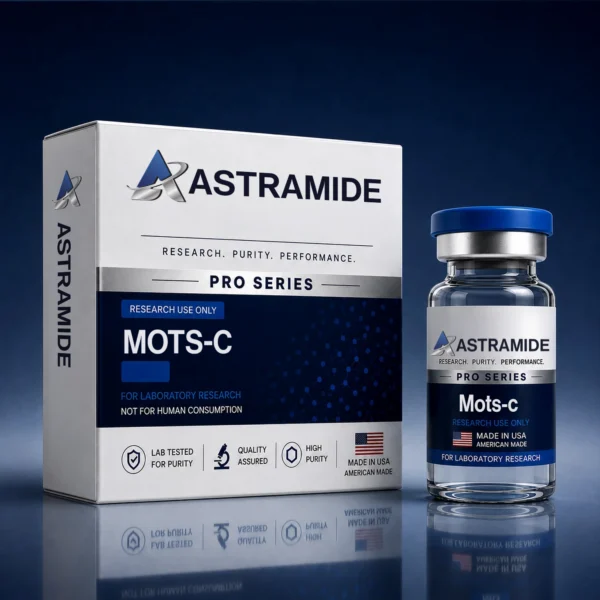
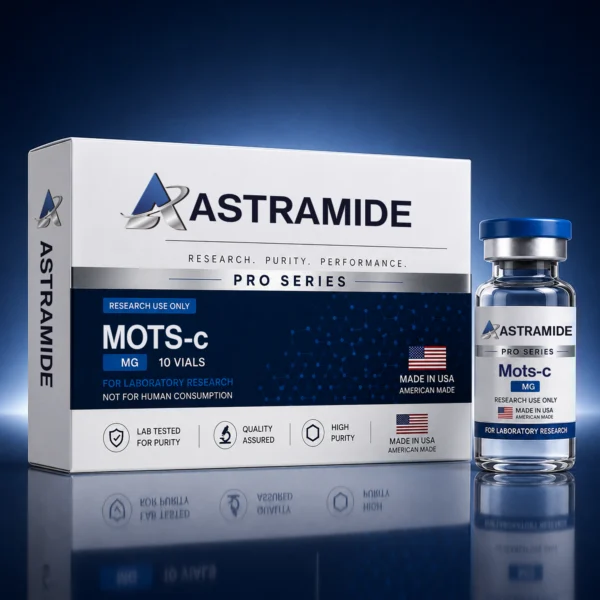
MOTS-c is a linear 16-amino-acid peptide (MRWQEMGYIFYPRKLR) encoded by a short open reading frame in the mitochondrial 12S rRNA gene. Its molecular formula is C101H152N28O22S2, its molecular weight is about 2174.6 g/mol and its CAS number is 1627580-64-6. MOTS-c Pro is supplied as a lyophilized powder. Sold for research use only.
What has MOTS-c been examined for in published research?
Published studies have examined how MOTS-c inhibits the folate cycle and de novo purine synthesis, leading to AICAR accumulation and AMPK activation in cell and mouse models (Lee et al., 2015, PMID 25738459). Later work examined its AMPK-dependent movement to the nucleus under metabolic stress (Kim et al., 2018, PMID 29983246). This work was pre-clinical. Astramide makes no claim about outcomes in humans.
What purity does the current MOTS-c Pro lot reach?
Lot NHS-MOT-20260817-09 returned 99% chromatographic purity by HPLC at 274 nm, reported by pH Solutions Lab on 29 September 2026 under certificate 260824-899-NHS-7. Identity was confirmed as a match to MOTS-c (C101H152N28O22S2, 2174.6 g/mol). The lot meets the Pro Series release criterion of at or above 99% HPLC purity. The full certificate is published on this page.
How much MOTS-c is in the vial?
The current certificate covers the 10 mg vial. For lot NHS-MOT-20260817-09, the laboratory measured 9.9184 mg of MOTS-c, which is 99.184% of the 10 mg label claim. Astramide publishes the measured figure exactly as the laboratory reports it, above or below the label. Net content and chromatographic purity are separate measurements.
How should MOTS-c be stored for research use?
Lyophilized MOTS-c is stored at -20°C and protected from light. Once reconstituted, the solution is held at 2 to 8°C and used within 14 to 30 days. Repeated temperature cycling and exposure to moisture should be avoided, because both can affect peptide stability and the comparability of experimental results.
Is MOTS-c encoded by mitochondrial or nuclear DNA?
MOTS-c is encoded by mitochondrial DNA. Its sequence comes from a short open reading frame inside the mitochondrial 12S rRNA gene, MT-RNR1, which places it in the mitochondrial-derived peptide family (Lee et al., 2015, PMID 25738459). Most peptide hormones studied in the laboratory are encoded by nuclear genes, which is why MOTS-c is studied as a mitochondrial-to-nuclear signaling molecule.
How is Astramide's MOTS-c Pro tested?
Lot NHS-MOT-20260817-09 was tested by pH Solutions Lab, an independent ISO/IEC 17025:2017 accredited laboratory (A2LA R243, PJLA Testing #84351). The certificate reports identity, chromatographic purity at 274 nm, net content, water content, pH, water activity, a 10-organism microbial panel, heavy metals, residual solvents, sterility and mycotoxins. Results apply only to this lot.
What is the difference between MOTS-c and MOTS-c Pro?
MOTS-c Pro is part of the Astramide Pro Series. It is American-made, synthesized in the USA, and moves by domestic ground and air only, with no ocean freight. It is released under its own lot, and only when HPLC purity measures at or above 99%. The full certificate for each lot is published on this page. The standard MOTS-c is released under separate lots with separate certificates.
Research use only
This product is intended strictly for in-vitro laboratory research conducted by qualified professionals.
It is not intended for human or animal consumption, clinical use, or therapeutic application.
The statements on this page have not been reviewed by the FDA. These research peptides are not intended
to diagnose, treat, cure, or prevent any disease. Research Use Only.
Select options
This product has multiple variants. The options may be chosen on the product page
Your Privacy Choices
We use analytics and advertising tools to understand how visitors find us and which campaigns work. You can turn either off. Your choice is saved in this browser.
AnalyticsGoogle Analytics and order source tracking. Helps us see how the site is used.
Off (browser signal)
AdvertisingMeta and X pixels, and server-side events. Opting out also opts you out of "sharing" and targeted advertising under state privacy laws.
Off (browser signal)
Your browser is sending a Global Privacy Control signal, so analytics and advertising are off. To change this, turn off the signal in your browser settings.
Strictly necessary cookies (cart, sign-in, checkout, entry acknowledgment) always stay on. See our Privacy Policy.
Know what's in the vial before you order.
Every Astramide batch is tested by an independent US lab. The report goes public before the batch goes on sale, so you can check the numbers first.
Independent US lab test on every batch
Full report published before it goes on sale
Kept frozen, shipped from Austin, Texas
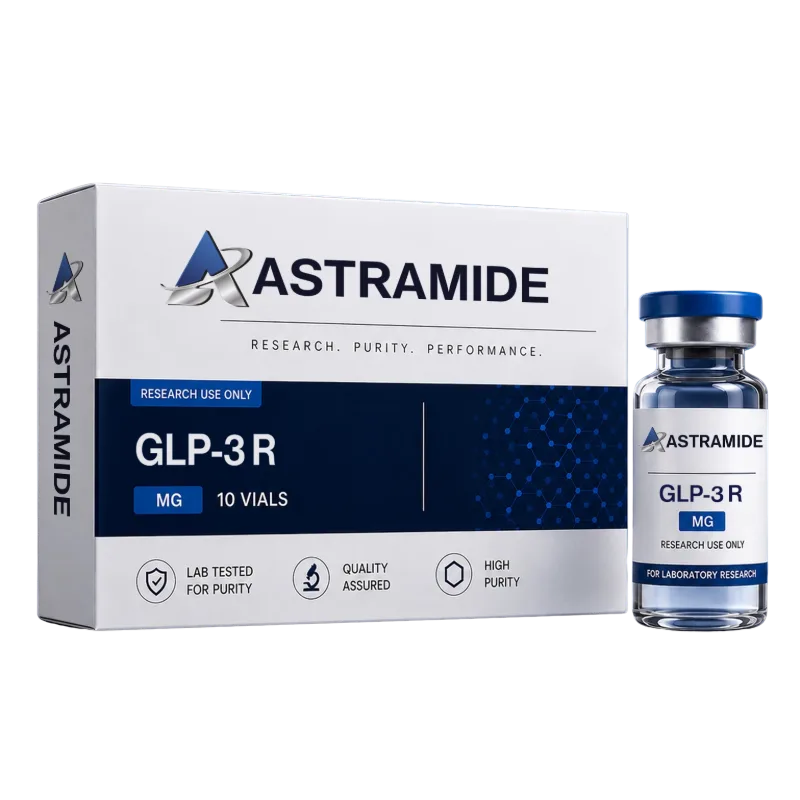
GLP-3RLot 2026/02 · May 8, 2026
>99.9%purity by HPLC-UV/MS
90%Minimum 98.0%100%
Identity: Confirmed by mass specEndotoxin: Below 0.5 EU/mL


 Pro Series
 Pro Series
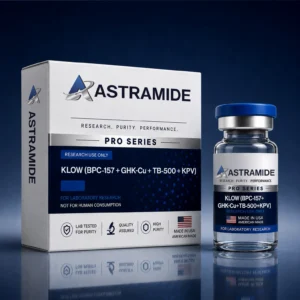 Pro Series