
All products are intended for research and identification purposes only. These products are not intended for human dosing, injection, or ingestion. The statements on this website have not been reviewed by the FDA. These research peptides are not intended to diagnose, treat, cure, or prevent any disease.
Short answer: Sellers in China and India sell direct at steep discounts, but buying direct can mean paying by crypto or wire, waiting on an international shipment and clearing US Customs. US-made peptides ship domestically from US sellers. Whatever the origin, check the test results for your lot.
How we compared: We used news reporting, import data, federal policy documents, FDA letters and company announcements dated 2025 and 2026, and recorded only what each source states. We do not rate countries or sellers. Astramide sells research peptides for research use only. Its Pro Series is made in the USA, and each published Astramide lot record names the lab that tested it.
Last reviewed: November 16, 2026. This market moves quickly; the update log records every change.
At a glance
- Price: sellers based in China or India sell directly to buyers "at steeply discounted prices" (The Hill, April 2026).
- Payment: a China-based seller offered Alipay or crypto to a Fortune reporter in 2026; an advisor told Fortune that card networks are wary of this market (Fortune, June 4, 2026).
- Customs: 15 of 127 peptide shipments the Partnership for Safe Medicines reviewed for Q1 2026 were refused at the US border (PSM).
- India: new Indian peptide lines in 2026 are built for drug-company customers (BioPharm International).
- USA: a US contract maker has described limited large-scale US peptide production, and US makers are adding capacity in 2026 (PharmTech).
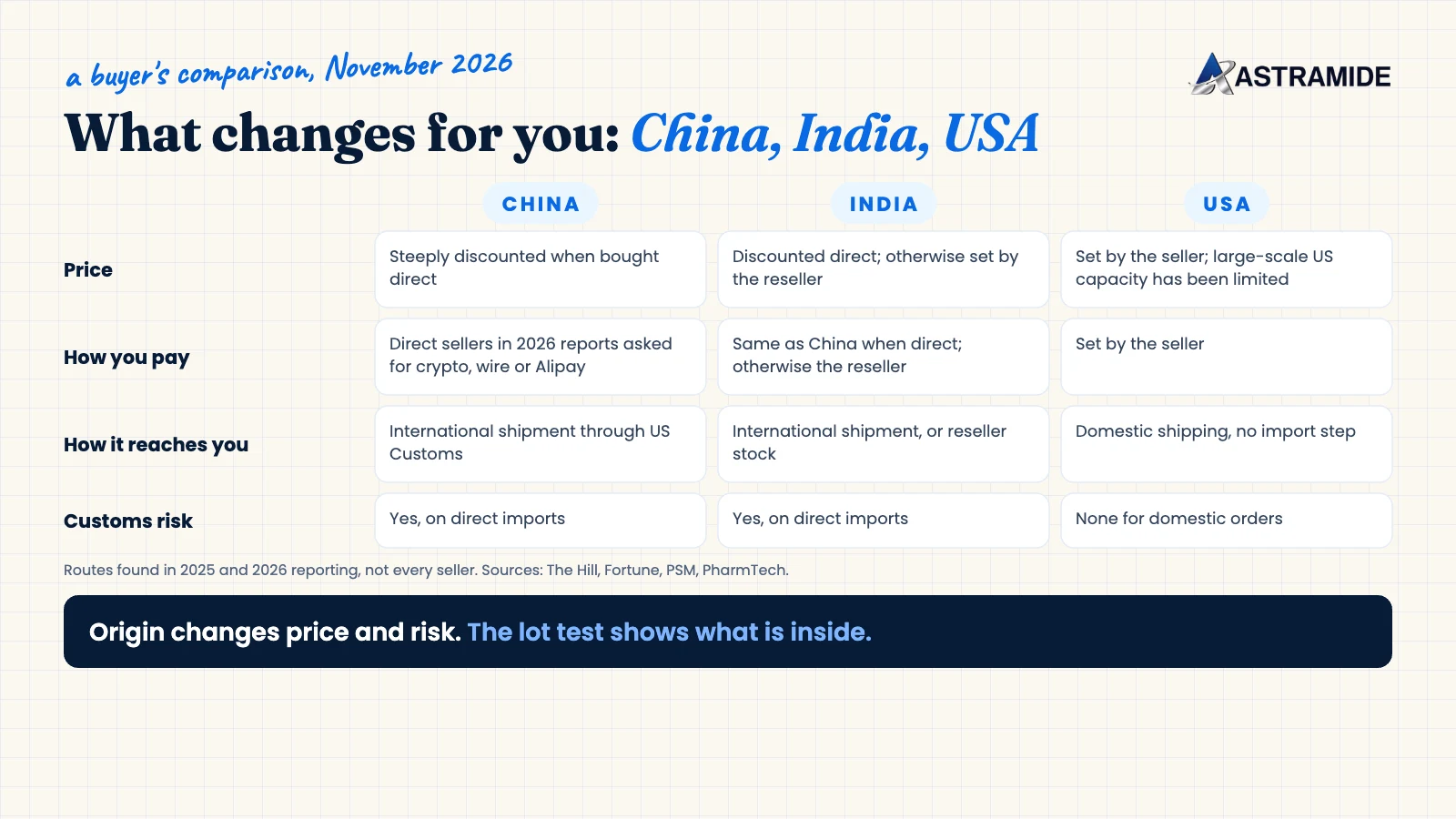
- China vs India vs USA, side by side
- What does buying Chinese peptides involve?
- Are peptides made in India?
- What does "made in USA" mean for buyers?
- How do the trade-offs compare?
- Does origin guarantee purity?
- What to check, whatever the origin
- How to check an Astramide lot
- Frequently Asked Questions
- Sources
Chinese, Indian and US-made peptides, side by side
Many research peptides are built the same way everywhere: amino acids are linked one at a time on a resin, then cut free and purified. Our peptide synthesis guide covers the chemistry. What changes by country is the price, how you buy, how the product reaches you and who answers for it.
| For the buyer | China | India | USA |
|---|---|---|---|
| Price | Steeply discounted when bought direct, per 2026 reporting | Steeply discounted when bought direct; otherwise set by the reseller | Set by the seller; large-scale US capacity has been limited |
| How you buy | Direct from sellers on forums and chat apps, or through resellers | Direct from sellers on forums and chat apps, or through resellers; new factories serve drug companies | From sellers in the US |
| How you pay | In two 2026 reports, direct sellers asked for crypto, wire or Alipay; one did not accept PayPal | Same questions as China when bought direct; otherwise set by the reseller | Set by the seller |
| How it reaches you | International shipment through US Customs | International shipment, or from a reseller's stock | Domestic shipping, no import step |
| Customs risk | Yes, on direct imports | Yes, on direct imports | None for domestic orders |
| Who answers for it | On direct orders, a seller outside the US | On direct orders, a seller outside the US; otherwise the reseller | A seller in the US, subject to US law and FDA oversight |
Rows draw on the reports linked below. The table describes routes those reports found, not every seller.
What does buying Chinese peptides involve?
"Chinese peptides" usually means peptides bought directly from China-based sellers, skipping a US distributor. The New York Times reported on the term's use in Silicon Valley in January 2026 (New York Times). China has a large base of chemical and peptide makers, from major contract manufacturers to small catalog sellers.
Why are Chinese peptides cheaper?
Buyers can find sellers based in China or India on forums and chat apps that sell directly at steeply discounted prices (The Hill). In one 2026 order, a Fortune reporter paid $49 for a product plus $60 for overnight shipping (Fortune).
How do you pay, and what if something goes wrong?
In two 2026 reports, direct sellers took payment outside the card networks. In The Hill's report, an overseas seller asked for crypto or wire transfer and did not accept PayPal. In Fortune's report, the seller proposed Alipay or crypto, and an advisor said Visa and Mastercard are wary of this market. A crypto or wire payment is hard to reverse, so check the seller before you pay.
How does it reach you?
A direct order is an import. It must clear US Customs, and import alerts let FDA detain shipments from listed firms. In Q1 2026, 15 of 127 peptide shipments in the Partnership for Safe Medicines review were refused at the border (PSM).
Why are Chinese sellers in the news?
Coverage centers on the catalog end of the market. In October 2026, TRM Labs reported tracking more than 150 Chinese chemical makers that accept crypto, about 75% of which listed both fentanyl precursors and peptides (TRM Labs). Large contract manufacturers are a different business. Where a seller is based does not show what is in its vials; a lot test does.
Are peptides made in India?
Yes, and capacity is growing. India has long exported bulk drug ingredients, the raw material finished products are made from, to US drug makers. In 2026, Indian contract manufacturers moved into commercial peptide production:
- Neuland Laboratories brought its first commercial peptide line online in 2026, with 6,370 liters of synthesis reactors (Manufacturing Chemist; BioSpectrum).
- Shilpa, an Indian contract manufacturer, committed $50 million to new peptide reactors (10,000 liters), with the first line opening December 2026 (BioPharm International). The site is described as 100% export oriented (BioXconomy).
What it means for you: this capacity is built for drug companies, so research buyers who meet Indian supply likely do so through resellers. Ask the reseller who tested the lot. Some India-based sellers also sell direct, with the same payment and customs questions as China (The Hill).
What does "made in USA" mean for buyers?
It means a shorter, domestic supply chain with smaller capacity. SK pharmteco, a contract maker in California, has described limited availability of reliable large-scale peptide production and purification within the US, and is adding small-batch peptide production built to drug-manufacturing (GMP) standards in 2026 (PharmTech). AmbioPharm announced an expansion of its South Carolina peptide site on March 24, 2026 (AmbioPharm).
Policy points the same way. The BIOSECURE Act became law on December 18, 2025, and limits federal contracts and grants tied to designated "biotechnology companies of concern"; the federal list is due by December 2026 (Arnold & Porter).
What it means for you: a domestic order skips customs and international transit, and a seller in the US is subject to US law and FDA oversight.
the trade-offs, side by sideHow do the trade-offs compare?
- Price: direct orders from sellers in China or India were steeply discounted in 2026 reporting. The trade-off is less common payment methods, an international shipment and a customs step.
- Delivery: a domestic order skips customs and international transit.
- Accountability: a seller in the US is subject to US law and FDA oversight. A seller outside the US is harder to reach if something goes wrong.
Every route leads to the same last step: a test of the specific lot by a named lab, with results you can look up.
Does country of origin guarantee purity?
No. In 2026, FDA cited makers in all three countries:
- China: a registered firm relabeled a bulk peptide ingredient made by two unlisted suppliers and shipped it to the US under its own name (FDA warning letter, May 2026).
- India: FDA found maintenance records marking equipment "ok" despite observed problems (FDA warning letter, May 2026).
- USA: FDA warned a New Jersey firm for not requesting, receiving or keeping certificates of analysis for incoming products (RAPS, August 2026).
Origin narrows the question. The lot test answers it. On October 28, 2026, HHS set a related rule for compounding pharmacies: its interim policy requires the original maker to be FDA-registered and named by location on the certificate of analysis (Holland & Knight). That policy applies to pharmacies, not research sellers. Our HHS peptide policy explainer has the details. This is general information, not legal advice; see also are peptides legal in the US.
What should a buyer check, whatever the origin?
Use the same six checks on a Chinese, Indian or US-made lot:
- Lot match. The lot number on the vial matches the lot on the certificate.
- Named independent lab. The certificate names a lab that is not the maker or the seller.
- Test date. The date is recent and falls after the lot was made.
- Purity and identity. A purity result from HPLC, a lab test that separates and measures what is in the sample, plus an identity test such as mass spectrometry, which confirms the molecule by its weight.
- Look it up. The report can be checked at the lab by accession number, key or QR code.
- Retest option. You can send a sample to a lab of your choice.
Our guide to reading a peptide COA walks through each field, and our peptide testing labs comparison lists where samples can be sent.
What should you ask a seller before you pay?
Copy these five questions and send them to any seller. A seller with good records can answer all of them.
- Which lab tested this lot, and where can I see its report?
- What is the lot number, and does it match the vial label?
- When was this lot tested?
- Can I check the report on the lab's own website?
- Can I send a sample to a lab of my choice, and what happens if it fails?
Where can you check a lab report?
Many labs let anyone check a report on their own site, using the code, number or QR code printed on it. As listed on each lab's site on November 9, 2026:
- Janoshik: task number and key on its verification page
- Freedom Diagnostics Testing: accession number on its COA search
- Krause Analytical: its CoA verification page
- Vanguard Laboratory: its report search
- Finnrick: certificate ID on its verify page (account required)
If a report cannot be found at the lab, ask the seller why before you buy.
How to check an Astramide lot
Published Astramide lot records name the lab that tested the lot, the test date and the results, so you can see which lab tested each published lot. The library also includes rejected lots, marked as not sold. Browse the COA library, read our testing process, or send any vendor's sample to our testing service.
Our Pro Series is American-made. Every batch is tested in the USA. All Astramide products are for research use only.
Frequently Asked Questions
Reporters in 2026 found sellers in China and India selling direct at steeply discounted prices, with no US distributor in between. The trade-offs are payment by crypto, wire or Alipay, an international shipment that must clear US Customs, and testing the lot yourself.
A trustworthy certificate names the testing lab, matches the lot number on the vial, shows a test date and reports both purity (HPLC) and identity (mass spectrometry). Where the lab offers a lookup, you can check it on the lab's own website. Be wary of a certificate with no lab name, no lot number, or the same purity figure on every lot.
Ask which lab tested your lot, then look up the report on that lab's website using the code on the certificate. Confirm the lot number matches your vial and the test date is recent. If the seller cannot answer, or the report cannot be found, ask why before you buy. You can also send a sample to an independent lab.
Some are and some are not; the label covers everything from large contract manufacturers to anonymous catalog sites. In 2026, FDA warned a registered Chinese firm for relabeling a bulk ingredient made by unlisted suppliers. The reliable check is an independent HPLC and mass spectrometry test of the specific lot, verifiable at the lab, not the country on the label.
The chemistry is the same. The differences are price, how you buy and pay, delivery and who answers for the product. Chinese peptides bought direct are often discounted but come by international shipment, and in 2026 reports sellers asked for crypto, wire or Alipay. US-made peptides bought from a US seller ship domestically, and the seller is subject to US law. Each lot still needs its own test.
Yes. Indian contract manufacturers such as Neuland Laboratories and Shilpa added commercial peptide lines in 2026, built mainly for drug-company customers. Research buyers likely meet Indian supply through resellers, so ask the reseller who tested the lot.
Yes. FDA can refuse imported shipments at the border, and import alerts let it detain shipments from listed firms. In the Q1 2026 import data reviewed by the Partnership for Safe Medicines, 15 of 127 peptide shipments were refused. A domestic order has no import step. This is general information, not legal advice.
No. A US maker means a shorter supply chain, but FDA warned US drug firms in 2026 too, including one that kept no certificates of analysis for incoming products. Purity is shown by an independent test of each lot, with HPLC for purity and mass spectrometry for identity.
Update log
- November 16, 2026: Published.
Sources
- The Hill (republished by ABC27), report on the gray market for peptides, April 30, 2026, abc27.com
- Fortune, Ben Weiss, peptides and crypto payments, June 4, 2026, fortune.com
- Partnership for Safe Medicines, Q1 2026 peptide import data, June 9, 2026, safemedicines.org
- TRM Labs, Chinese chemical vendors and peptides, October 6, 2026, trmlabs.com
- New York Times, "Chinese Peptides" in Silicon Valley, January 3, 2026, nytimes.com
- Manufacturing Chemist, Neuland Laboratories commercial peptide facility, 2026, manufacturingchemist.com; BioSpectrum, September 15, 2026, biospectrumindia.com
- BioPharm International, Shilpa $50 million peptide expansion, November 3, 2026, biopharminternational.com; BioXconomy, bioxconomy.com
- PharmTech, SK pharmteco domestic peptide facility, October 2025, pharmtech.com
- AmbioPharm, North Augusta, SC expansion, March 24, 2026, ambiopharm.com
- Arnold & Porter, "The BIOSECURE Act Becomes Law in the United States," December 2025, arnoldporter.com
- FDA warning letter 320-26-73, Harbin Jixianglong Biotech, May 1, 2026, fda.gov
- FDA warning letter 320-26-77, Alchymars ICM SM, May 21, 2026, fda.gov
- RAPS, "US FDA warns drugmakers in India, China and the US for GMP issues," August 25, 2026, raps.org
- Holland & Knight, HHS interim enforcement discretion policy, November 4, 2026, hklaw.com
All products are intended for research and identification purposes only. These products are not intended for human dosing, injection, or ingestion. The statements on this website have not been reviewed by the FDA. These research peptides are not intended to diagnose, treat, cure, or prevent any disease.