

All products are intended for research and identification purposes only. These products are not intended for human dosing, injection, or ingestion. The statements on this website have not been reviewed by the FDA. These research peptides are not intended to diagnose, treat, cure, or prevent any disease.
Short answer: KLOW peptide is a four-peptide blend sold as one lyophilized solid: GHK-Cu 50 mg, BPC-157 10 mg, TB-500 10 mg and KPV 10 mg, for 80 mg nominal per vial. It is a trade name, not one molecule, and not an FDA-approved drug. A Europe PMC search on November 3, 2026 found no primary study of the four combined.
At a glance
- 4 components, 80 mg nominal: GHK-Cu 50 mg plus 10 mg each of BPC-157, TB-500 and KPV.
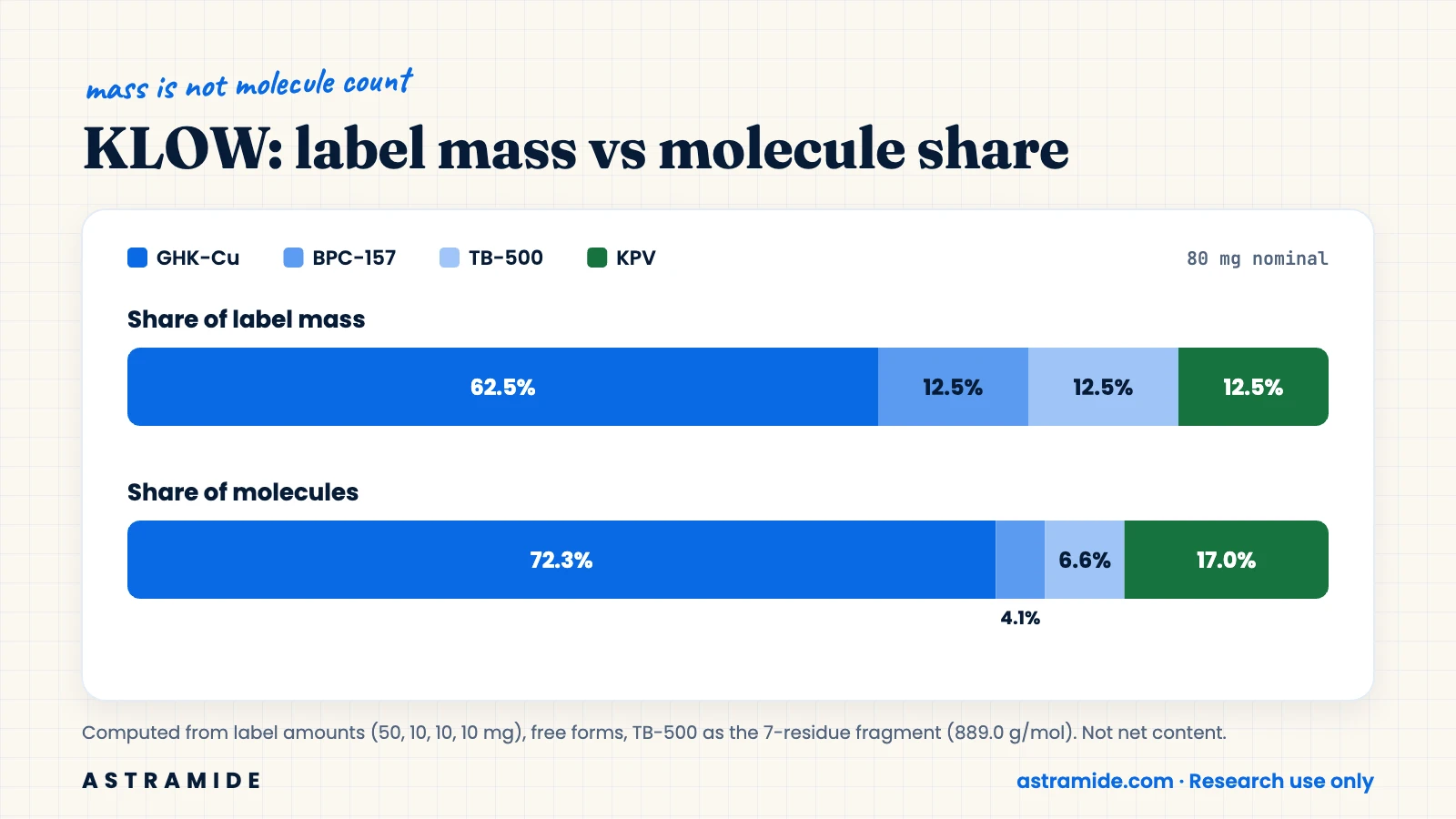
- 62.5% of the mass, about 72 to 76% of the molecules: GHK-Cu.
- 5.6-fold: the swing in TB-500 molecule count, fragment or full-length thymosin beta-4.
- About 7.9 mg of copper: in 50 mg nominal GHK-Cu (computed estimate).
- 1 hit, 0 primary studies: Europe PMC search for all four, November 3, 2026.
- 2 published lots, 2 labs: KLOW at 99.4% (Krause Analytical, May 19, 2026) and KLOW Pro at 99.11% (Optiq Health Labs, August 8, 2026).
- What is KLOW peptide?
- What is in a KLOW vial? The four ingredients by label
- How many molecules of each peptide does 80 mg hold?
- Why does the TB-500 entry change the arithmetic?
- What is each component, structurally?
- What does KLOW peptide do? What has research examined for each part?
- Has KLOW been studied as a four-peptide blend?
- What does a KLOW certificate have to show?
- How do the two published KLOW panels compare?
- Why does a KLOW certificate report water activity?
- What is the regulatory status of KLOW?
- Batch Verification Standards
- Frequently Asked Questions
- Sources
What is KLOW peptide?
KLOW peptide is a blend of four peptides sold together in one vial as a freeze-dried powder: GHK-Cu, BPC-157, TB-500 and KPV, labelled 50, 10, 10 and 10 mg. The name is a market label for the mixture.
KLOW is not a compound with a structure of its own. No part is an FDA-approved drug, and the mixture has no approval either.
This page approaches KLOW peptides as chemistry. For a side-by-side with the three-peptide blend, see how KLOW differs from GLOW.
What is in a KLOW vial? The four ingredients by label
The KLOW blend label lists four ingredients in an 80 mg nominal fill.
| Component | What it is | Formula | Molar mass (g/mol) | Label amount | Share of label mass |
|---|---|---|---|---|---|
| GHK-Cu | Gly-His-Lys tripeptide bound to one copper(II) ion | C14H24CuN6O4 | 403.9 | 50 mg | 62.5% |
| BPC-157 | 15-residue peptide | C62H98N16O22 | 1,419.54 | 10 mg | 12.5% |
| TB-500 | 7-residue thymosin beta-4 fragment, or full-length thymosin beta-4 | C38H68N10O14 (fragment) or C212H350N56O78S (full length) | 889.0 (fragment) or 4,963.4 (full length) | 10 mg | 12.5% |
| KPV | Lys-Pro-Val tripeptide, free acid | C16H30N4O4 | 342.43 | 10 mg | 12.5% |
Formulas: PubChem (GHK-Cu, CID 378611; BPC-157, CID 108101; thymosin beta-4, CID 45382195; KPV, CID 125672) and the HHS appendix (HHS, 2026). The 889.0 g/mol fragment mass is computed from its free formula.
counted, not weighedHow many molecules of each peptide does 80 mg hold?
Mass share and molecule share differ. A small molecule packs more copies into each milligram.
Method
Molar masses are sums of standard atomic masses (C 12.011, H 1.008, N 14.007, O 15.999, Cu 63.546, S 32.06). Amount in µmol is label mg divided by molar mass, times 1,000. Label figures are nominal fill amounts, not net peptide content, with no counterion correction. Our guide to net peptide content explains why the two differ.
| Component and form | Molar mass used (g/mol) | Label amount | µmol per vial (nominal) |
|---|---|---|---|
| GHK-Cu | 403.9 | 50 mg | 123.8 |
| BPC-157, free peptide | 1,419.54 | 10 mg | 7.04 |
| TB-500 fragment, free peptide | 889.0 | 10 mg | 11.25 |
| TB-500 fragment, mono-acetate | 949.1 | 10 mg | 10.54 |
| Full-length thymosin beta-4 | 4,963.4 | 10 mg | 2.01 |
| KPV, free acid | 342.43 | 10 mg | 29.2 |
| KPV, acetate | 402.5 | 10 mg | 24.8 |
Share of molecules under three readings of the label
| Reading of the label | Total µmol | GHK-Cu | BPC-157 | TB-500 | KPV |
|---|---|---|---|---|---|
| A: free forms, TB-500 as the fragment | 171.3 | 72.3% | 4.1% | 6.6% | 17.0% |
| B: free forms, TB-500 as full-length thymosin beta-4 | 162.1 | 76.4% | 4.3% | 1.2% | 18.0% |
| C: HHS acetate forms (TB-500 949.1, KPV 402.5) | 166.2 | 74.5% | 4.2% | 6.3% | 14.9% |
GHK-Cu is 62.5% of the label mass but about 72 to 76% of the molecules. KPV, the smallest component, is 12.5% of the mass but about 15 to 18% of the molecules. BPC-157 is only about 4%. As ratios, there are about 17.6 GHK-Cu molecules per BPC-157 molecule, 4.2 to 1 against KPV free acid (5.0 to 1 as acetate), and 11.0 to 1 against the TB-500 fragment, or 61.4 to 1 against full-length thymosin beta-4.
Why does the TB-500 entry change the arithmetic?
"TB-500" can name two molecules. Regulators use it for a short fragment. HHS defines TB-500 acetate as Ac-Leu-Lys-Lys-Thr-Glu-Thr-Gln-OH with one acetic acid, C38H68N10O14·CH3COOH, 949.1 g/mol (HHS, 2026). Without the acetate, the free peptide C38H68N10O14 is 889.0 g/mol. The FDA lists "Thymosin beta-4, fragment (LKKTETQ), also known as TB-500" (FDA, 2026).
One 2012 analysis identified Ac-LKKTETQ, residues 17 to 23 of thymosin beta-4, in a product sold as TB-500 (Esposito et al., 2012). Another named the same N-acetylated segment as the key ingredient of a preparation called TB-500 (Ho et al., 2012).
Full-length thymosin beta-4 is a 43-residue protein of about 4.9 kDa (Sosne et al., 2007), 4,963.4 g/mol by formula. Ten milligrams of the fragment is about 11.25 µmol, of the full protein about 2.01 µmol: a 5.6-fold gap. The GLOW peptide research overview tells the full naming story.
What is each component, structurally?
GHK-Cu: a tripeptide holding one copper ion
GHK binds copper(II) mainly as a 1:1 complex. Three nitrogen atoms grip the metal: the N-terminal amine, a backbone amide nitrogen and the histidine imidazole nitrogen. The fourth coordination site stays open. The reported log K1 is 12.62, and the conditional dissociation constant at pH 7.4 is 0.24 pM. A weak 1:2 species, Cu(GHK)2, also forms (Bossak-Ahmad et al., 2020).
The free tripeptide, C14H24N6O4, computes to 340.4 g/mol, and the complex to 403.9 g/mol. On a 1:1 basis, 50 mg of nominal GHK-Cu holds about 7.9 mg of copper (50 ÷ 403.9 × 63.546), a computed estimate, not a measured value. GHK was first isolated from human plasma in 1973 (Pickart et al., 2015).
BPC-157: a 15-residue linear peptide
BPC-157 is a 15-residue peptide first described from gastric juice (Vasireddi et al., 2025). HHS gives it as C62H98N16O22, 1,419.54 g/mol for the free peptide, plus about 60.05 g/mol for each acetate (HHS, 2026).
KPV: the last three residues of alpha-MSH
In UniProt entry P01189, alpha-MSH is residues 138 to 150 of POMC, SYSMEHFRWGKPV. KPV is residues 11 to 13 of that sequence. As supplied, it is a free acid, C16H30N4O4, 342.43 g/mol (PubChem CID 125672), or an acetate at 402.5 g/mol (HHS, 2026).
What does KLOW peptide do? What has research examined for each part?
No study has tested what KLOW does as a blend. Our Europe PMC search found no primary study of the four peptides together. Research has examined each of its four parts on its own, mostly in cell and animal models, and none of the studies below used KLOW.
GHK-Cu. A review reported that GHK-Cu stimulated collagen and glycosaminoglycan synthesis at 1 to 10 nM in cell culture (Pickart et al., 2015).
BPC-157. A 2025 systematic review found 36 studies. Thirty-five were preclinical and one was clinical (Vasireddi et al., 2025). Our summary of BPC-157 and the VEGFR2 and nitric oxide pathway covers one mechanism in depth.
Thymosin beta-4. In an animal model, full-length Tβ4 was associated with 42% more re-epithelialization than saline at day 4, and up to 61% more at day 7. Keratinocyte migration in vitro rose 2 to 3 times (Malinda et al., 1999). That study used the full protein, not the fragment.
KPV. In cell lines, KPV was associated with lower NF-κB and MAPK activation. Uptake experiments pointed to the PepT1 transporter as its route into cells (Dalmasso et al., 2008). Our KPV peptide research hub covers each study and both KPV lot records.
For more depth on the first three components, see the GLOW peptide hub.
no blend data foundHas KLOW been studied as a four-peptide blend?
No primary study of the four peptides together was found. On November 3, 2026, we searched Europe PMC, which indexes PubMed and MEDLINE records, with this query:
(KPV OR "Lys-Pro-Val") AND ("BPC-157" OR "BPC 157") AND (GHK OR "copper peptide") AND (thymosin OR "TB-500")
It returned one record, a 2026 review (Renke and Chinellato, 2026), not an experiment on the mixture. A second query, KLOW AND (peptide OR GHK OR KPV), returned 64 records. The 47 parsed from the first page were all unrelated author-name and acronym matches.
Single-component data do not carry over to a mixture. The four molecules differ widely in size, from 342 to as much as 4,963 g/mol (see the composition table above). One of them holds a metal ion with an open coordination site (Bossak-Ahmad et al., 2020). We found no primary research reporting how the four behave together, in a solid or in solution.
What does a KLOW certificate have to show?
Four identities need four matches
In LC-MS work, each analyte has been identified by its retention time together with the relative abundances of its major product ions (Ho et al., 2012). A four-part blend needs four matches. See how HPLC and mass spectrometry differ.
Which reference form was used?
Two components come in more than one form. TB-500 can be the fragment as a free peptide (889.0), its acetate (949.1) or the full protein (4,963.4). KPV can be the free acid (342.43) or the acetate (402.5) (HHS, 2026). A mass match only means something against a stated reference.
Does the purity figure cover the blend or each part?
A single purity number on a blend certificate may describe the target peaks together rather than each component. Check which the lab reported, and by which method. Our guide on how to read a peptide COA shows where each figure sits on a certificate.
two labs, two menusHow do the two published KLOW panels compare?
Two published lots, two labs, two test menus:
| Test | KLOW lot 2026/02 (Krause Analytical) | KLOW Pro lot SD-260729-1 (Optiq Health Labs) |
|---|---|---|
| Received and reported | April 28 and May 19, 2026 | August 3 and August 8, 2026 |
| Identity | Confirmed: mass spectral match to the labelled compound (HPLC-UV-MS), one result | LC-MS: all four labelled components present, no per-component mass |
| Chromatographic purity | 99.4% (HPLC-UV/MS) | 99.11% (RP-HPLC) |
| Endotoxin | <0.5 EU/mL (LAL, USP <85>) | Pass, ≤0.05 EU/mg (LAL) |
| pH | Not reported | 5.7 (specification 5.0 to 8.0) |
| Water activity | Not reported | 0.35 aw, pass |
| Sterility | Not reported | USP <71>, pass, no growth |
| Yeast and mold | Not reported | USP <61>/<62>, pass |
| Residual solvents | Not reported | GC-MS, pass (20 analytes, 0 µg/g) |
| Heavy metals | Not reported | ICP-OES, pass (As, Cd, Pb, Hg not detected) |
The Optiq panel adds six tests to the Krause set. The endotoxin results use different units, per mL and per mg, so they do not compare directly.
On identity, neither certificate gives a separate mass for each component. Neither states which TB-500 form or which KPV salt form served as the identity reference. Both product pages describe the TB-500 component as "thymosin beta-4 peptide."
Why does a KLOW certificate report water activity?
KLOW is supplied as a lyophilized solid, and residual water still matters in a dry solid. In one study of a lyophilized formulation, a model hexapeptide in a PVP matrix, higher moisture raised the rate of deamidation. Water acted through matrix mobility, as a solvent and as a reactant (Lai et al., 1999). That was a model peptide, not KLOW. It shows why a lab may report water activity on a dry blend, as the Optiq certificate does (0.35 aw). For a buyer, the point is that a dry solid can still change with moisture, so a moisture result on the certificate is useful data.
What is the regulatory status of KLOW?
This is general information, not legal advice.
KLOW is not an FDA-approved drug, and none of its four components is either. Astramide supplies KLOW and KLOW Pro as research chemicals, for research use only.
On October 30, 2026, HHS published an interim 503A enforcement discretion policy for listed peptides (FR Doc 2026-22192, 91 FR 68526). The notice states: "Compounded drugs are not FDA-approved." Its appendix lists six peptides, including BPC-157, TB-500 (as the fragment) and KPV, but not GHK-Cu. Condition 7 limits the policy to a single listed active ingredient (HHS, 2026). A four-part blend is not a single ingredient, so KLOW falls outside the policy, even with three listed parts.
An FDA bulk drug substances page lists BPC-157 and the TB-500 fragment (FDA, 2026). For the wider picture, read our HHS peptide policy explainer and are peptides legal.
published, lot by lotBatch Verification Standards
The two current KLOW lots, as printed:
Chromatographic purity (HPLC-UV/MS)
99.4%
Chromatographic purity (RP-HPLC)
99.11%
Both lots carry the same 80 mg label. Each record links to the full certificate. Both products are supplied for research use only. Every lot is in the Astramide COA library, and our testing process page sets out the release steps. For a field-by-field method, see how to read a peptide COA.
Frequently Asked Questions
KLOW peptide is a trade name for a freeze-dried mixture of four peptides in one vial: GHK-Cu, BPC-157, TB-500 and KPV. Each part is a separate molecule. Neither the mixture nor any of its parts is an FDA-approved drug. Astramide supplies KLOW for laboratory research use only.
KLOW peptide has four ingredients. A vial is labelled 80 mg nominal: 50 mg GHK-Cu and 10 mg each of BPC-157, TB-500 and KPV. GHK-Cu is 62.5% of the mass and about 72 to 76% of the molecules. KPV, the smallest component, is about 15 to 18% of the molecules. These are nominal figures from label amounts.
Not confirmed. Neither published KLOW certificate reports the color of the lot. If a lot looks blue, GHK-Cu is the likely source: of the four ingredients, only it carries a metal ion. GHK binds copper(II) mainly as a 1:1 complex, tracked by its visible absorbance near 605 nm (Bossak-Ahmad et al., 2020). Compounds that absorb in the orange range near 605 nm typically appear blue.
Not as a blend. A Europe PMC search on November 3, 2026, combining terms for KPV, BPC-157, GHK and thymosin or TB-500, returned one record, a 2026 review. No primary study of the four together was found. Research has examined each component alone, mostly in cell and animal models.
No study has tested what the KLOW blend does. A Europe PMC search on November 3, 2026 found no primary study of its four peptides together. Research has examined each part alone, mostly in cell and animal models, for example GHK-Cu and collagen synthesis in cell culture (Pickart et al., 2015) and KPV and NF-κB signaling in cell lines (Dalmasso et al., 2008). KLOW is supplied for laboratory research use only.
Check the certificate. "TB-500" can mean the 7-residue fragment Ac-LKKTETQ (889.0 g/mol free, 949.1 g/mol as the HHS acetate) or full-length thymosin beta-4 (4,963.4 g/mol). Astramide's KLOW product pages describe the component as "thymosin beta-4 peptide." Neither published KLOW certificate states which form served as the identity reference.
No. KLOW is not FDA approved, and none of its four components is an FDA-approved drug. The HHS interim 503A policy of October 30, 2026 lists BPC-157, TB-500 and KPV but not GHK-Cu, and it covers a single listed ingredient only. A four-part blend falls outside it. KLOW is supplied for research use only. This is general information, not legal advice.
Update log
- November 4, 2026: Published.
Sources
- Bossak-Ahmad K, et al. Int J Mol Sci. 2020. PMID 32867146. PMC7503498
- Pickart L, et al. Biomed Res Int. 2015. PMID 26236730. PMC4508379
- Vasireddi N, et al. HSS J. 2025. PMID 40756949. PMC12313605
- Sosne G, et al. Clin Ophthalmol. 2007. PMID 19668473. PMC2701135
- Malinda KM, et al. J Invest Dermatol. 1999. PMID 10469335. PubMed
- Esposito S, et al. Drug Test Anal. 2012. PMID 22962027. PubMed
- Ho EN, et al. J Chromatogr A. 2012;1265:57-69. PMID 23084823. PubMed
- Dalmasso G, et al. Gastroenterology. 2008. PMID 18061177. PMC2431115
- Lai MC, et al. J Pharm Sci. 1999;88(10):1081-9. PMID 10514359. PubMed
- Renke G, Chinellato L. Int J Mol Sci. 2026. PMID 42123471. PMC13164565
- US HHS. 503A Peptide Enforcement Discretion Policy, Appendix A and B. 2026. HHS PDF
- US HHS. Federal Register. FR Doc 2026-22192, 91 FR 68526. October 30, 2026. Public inspection PDF
- US FDA. Bulk drug substances that may present significant safety risks. Current as of April 22, 2026. FDA.gov
- Databases: PubChem CIDs 378611, 108101, 45382195 and 125672; UniProt entry P01189; Europe PMC search, November 3, 2026.
All products are intended for research and identification purposes only. These products are not intended for human dosing, injection, or ingestion. The statements on this website have not been reviewed by the FDA. These research peptides are not intended to diagnose, treat, cure, or prevent any disease.