

All products are intended for research and identification purposes only. These products are not intended for human dosing, injection, or ingestion. The statements on this website have not been reviewed by the FDA. These research peptides are not intended to diagnose, treat, cure, or prevent any disease.
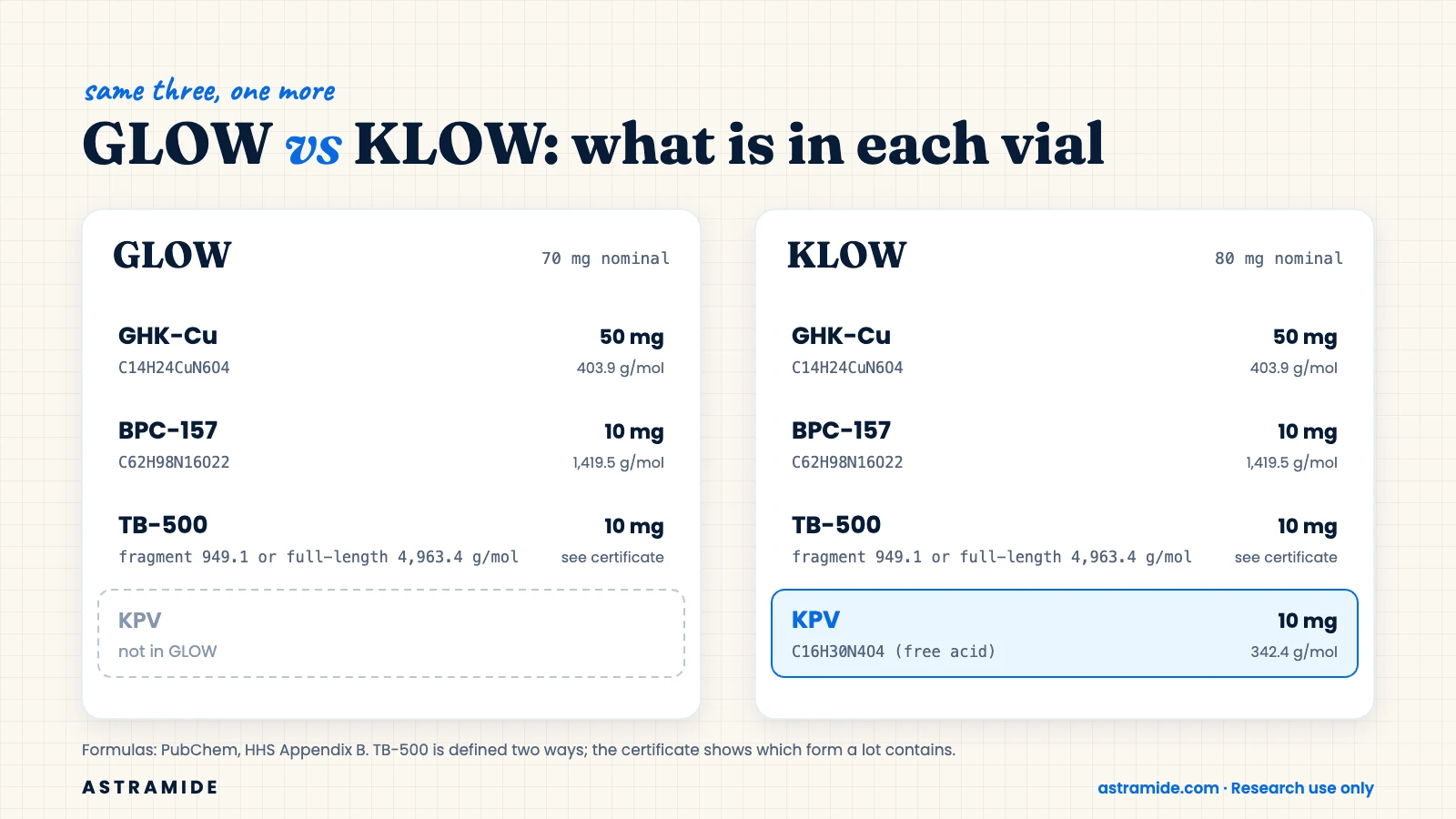
Short answer: In GLOW vs KLOW, the difference is one ingredient. GLOW is a blend of GHK-Cu, BPC-157 and TB-500 (70 mg nominal). KLOW is the same three plus KPV, the tripeptide Lys-Pro-Val (80 mg nominal). No study has tested either blend. The practical difference is analytical: a KLOW certificate has four identities to confirm, not three.
Chromatographic purity (HPLC-UV/MS)
99.4%
At a glance
- Composition: GLOW has 3 components (GHK-Cu 50 mg, BPC-157 10 mg, TB-500 10 mg). KLOW has 4, adding KPV 10 mg.
- Vial size: GLOW is 70 mg nominal. KLOW is 80 mg nominal.
- The extra molecule: KPV is free-acid Lys-Pro-Val, C16H30N4O4, 342.43 g/mol (PubChem CID 125672).
- Blend studies: a November 1, 2026 literature search found no primary study of KPV combined with any GLOW component.
- Lot data: GLOW lot 2026/02 tested at 99.5% and KLOW lot 2026/02 at 99.4% purity (Krause Analytical, May 19, 2026).
- Regulatory: neither blend falls inside the HHS interim 503A peptide policy published October 30, 2026 (general information, not legal advice).
- What is the difference between GLOW and KLOW?
- GLOW vs KLOW side by side
- What is KPV, the fourth component?
- What are the shared components?
- Has either blend been studied as a blend?
- What has preclinical research examined for KPV?
- How does a fourth component change the certificate?
- What is the regulatory status of GLOW and KLOW components?
- Batch Verification Standards
- Frequently Asked Questions
- Sources
What is the difference between GLOW and KLOW?
The klow vs glow peptide question has a short answer. KLOW is GLOW with one more peptide. Both are commercial names for lyophilized blends, not single molecules, and neither blend nor any of its components is an FDA-approved drug.
GLOW holds three peptides: GHK-Cu, BPC-157 and TB-500. The nominal label amounts are 50 mg, 10 mg and 10 mg, for 70 mg in total. KLOW holds the same three in the same amounts, plus 10 mg of KPV, for 80 mg in total.
A common question about glow vs klow is which blend is better. That is not a question the literature can answer, because neither blend has been studied as a blend. The useful comparison is chemical. What is the extra molecule? How is it defined? And what must a certificate show once a blend has four parts instead of three?
This post covers those points. For the full background on the three shared peptides, see our GLOW peptide research overview. For KLOW alone, including its molar breakdown, see our KLOW peptide research overview.
GLOW vs KLOW side by side
| Component | Formula | Molecular weight | GLOW | KLOW |
|---|---|---|---|---|
| GHK-Cu | C14H24CuN6O4 | 403.9 g/mol | 50 mg | 50 mg |
| BPC-157 | C62H98N16O22 | 1,419.54 g/mol | 10 mg | 10 mg |
| TB-500 (HHS/FDA fragment definition) | C38H68N10O14·CH3COOH (acetate) | 949.1 g/mol | 10 mg | 10 mg |
| KPV (free acid) | C16H30N4O4 | 342.43 g/mol | Not present | 10 mg |
| Total nominal | 3 vs 4 components | n/a | 70 mg | 80 mg |
Sources: PubChem CID 378611 and the GLOW Pro lot record (GHK-Cu), the HHS appendix (BPC-157, TB-500), PubChem CID 125672 (KPV). Some products sold as TB-500 contain full-length thymosin beta-4 instead (C212H350N56O78S, 4,963.4 g/mol; see the GLOW Pro lot record). The section on shared components explains this naming split.
What is KPV, the fourth component?
KPV is a tripeptide made of lysine, proline and valine. In UniProt entry P01189, alpha-melanocyte-stimulating hormone (alpha-MSH) is residues 138 to 150 of the precursor protein POMC, with the sequence SYSMEHFRWGKPV. KPV is residues 11 to 13 of that sequence, the last three.
Why the free acid vs amide detail matters
In alpha-MSH, the final valine carries a C-terminal amide. KPV as defined by HHS and by PubChem is different. It is the free acid, H-Lys-Pro-Val-OH. PubChem lists it as "Msh (11-13)", C16H30N4O4, 342.43 g/mol (CID 125672).
So the same three residues can exist in two forms. The amide and the free acid differ in structure and in mass. A mass spectral identity check is only meaningful if it is read against the right reference form.
Free base vs acetate salt
HHS Appendix B defines KPV as H-Lys-Pro-Val-OH acetate, C16H30N4O4·CH3COOH, with a molecular weight of 402.5 g/mol. PubChem lists the free base at 342.4 g/mol. The gap of about 60 g/mol is the acetate counterion. When a certificate gives a molecular weight for KPV, it should be clear which of the two it refers to.
For a longer KPV summary, see our KPV peptide research overview.
What are the shared components?
The three shared peptides are identical in both blends. Here is the short version. Our GLOW hub covers each one in depth.
GHK-Cu
GHK is the tripeptide Gly-His-Lys. Pickart isolated it in 1973 from the albumin fraction of human plasma. It has a strong affinity for copper, which forms the GHK-Cu complex (Pickart et al., 2015). GHK-Cu is C14H24CuN6O4, 403.9 g/mol.
BPC-157
BPC-157 is a 15-amino-acid peptide: H-Gly-Glu-Pro-Pro-Pro-Gly-Lys-Pro-Ala-Asp-Asp-Ala-Gly-Leu-Val-OH, C62H98N16O22, 1,419.54 g/mol (HHS Appendix B). A 2025 systematic review included 36 BPC-157 studies. Of these, 35 were preclinical and 1 was clinical (Vasireddi et al., 2025). We also summarize one pathway in BPC-157 and the VEGFR2 and NO pathway.
TB-500, and why the name means two things
HHS and FDA define TB-500 as the 7-residue fragment Ac-Leu-Lys-Lys-Thr-Glu-Thr-Gln-OH, C38H68N10O14·CH3COOH (acetate), 949.1 g/mol. Full-length thymosin beta-4 is a 43-amino-acid protein, C212H350N56O78S, 4,963.4 g/mol. It is the major actin-sequestering peptide in cells (Sosne et al., 2007).
A 2012 analysis found the fragment Ac-LKKTETQ, residues 17 to 23, in a product sold as TB-500 (Esposito et al., 2012). The FDA lists "Thymosin beta-4, fragment (LKKTETQ), also known as TB-500". Because the name covers two molecules, a certificate should say which one it confirmed. This applies equally to GLOW and KLOW.
the honest answerHas either blend been studied as a blend?
No. We found no primary study of GLOW or KLOW as a combination.
On November 1, 2026, we searched Europe PMC and PubMed records with this query:
(KPV OR "Lys-Pro-Val") AND ("BPC-157" OR GHK OR thymosin OR "TB-500")
It returned 9 hits. Four were reviews that list the peptides side by side. None was a primary study of a combination. A search for "GLOW peptide" returned 0 hits, and "KLOW" returned only unrelated surname matches.
Our October 30 search for the three GLOW components together found 7 hits, all general narrative reviews. Every research finding cited in this post comes from work on a single peptide, never on either blend. Claims about what a blend "does" have no primary data behind them.
What has preclinical research examined for KPV?
The studies below used KPV alone. None tested GLOW, KLOW or any combination.
A 1989 picryl chloride mouse ear assay
In a picryl chloride mouse ear assay, alpha-MSH [11-13] was associated with lower ear thickness measurements, with larger differences at higher concentrations. The abstract gives no figures (Hiltz and Lipton, 1989).
Cell lines and PepT1 uptake
In Caco2-BBE, HT29-Cl.19A and Jurkat cells, nanomolar KPV was associated with reduced NF-κB and MAPK activation and lower secretion of the cytokines measured. Competition experiments and [3H]KPV uptake showed the peptide entered cells via the PepT1 transporter. The same paper also reported cytokine mRNA measurements in two chemically exposed mouse models (DSS, TNBS) (Dalmasso et al., 2008).
MPO activity and the MC1R question
A second 2008 study used a DSS model and a T-cell transfer model in mice. It measured myeloperoxidase (MPO) activity and scored tissue histology as study endpoints, and reported differences from control animals. In mice with nonfunctional MC1R, the effects were "at least partially independent of MC1R signaling" (Kannengiesser et al., 2008). A 2023 review concluded that KPV likely acts through both MC1R-dependent and MC1R-independent mechanisms (Gravina et al., 2023).
These are measured endpoints in cells and animal models. They say nothing about how KPV behaves alongside GHK-Cu, BPC-157 or TB-500.
How does a fourth component change the certificate?
A blend is harder to verify than a single peptide. Each added component adds one more identity to confirm and one more peak to resolve. GLOW has three. KLOW has four.
What a KLOW certificate should name
- All four components, by name.
- An identity result for each, with a formula or mass.
- Which TB-500 form was confirmed: the 949.1 g/mol fragment or 4,963.4 g/mol thymosin beta-4.
- Which KPV form was the reference: free acid (342.4 g/mol) or acetate (402.5 g/mol), and not the amidated alpha-MSH end.
- Whether the purity figure covers the whole blend or each component.
Where our own records stand
We hold our records to the same list. The Krause Analytical records for GLOW lot 2026/02 and KLOW lot 2026/02 report identity as a single mass spectral match to the labelled compound (HPLC-UV-MS). They do not list a separate identity result for each component. The GLOW Pro record from pH Solutions Lab does list each component with its formula and mass. In that record, TB-500 is reported as full-length thymosin beta-4. The KLOW Pro record from Optiq Health Labs reports all four labelled components present by LC-MS, without a separate mass for each.
For how the two methods differ, see HPLC vs mass spectrometry. For a field-by-field walkthrough, see how to read a peptide COA.
What is the regulatory status of GLOW and KLOW components?
None of the components in either blend is an FDA-approved drug.
On October 30, 2026, HHS published an interim 503A peptide policy (FR Doc 2026-22192, 91 FR 68526). It covers six single peptides: BPC-157, Epitalon, KPV, MOTS-c, Semax and TB-500. GHK-Cu is not listed. Condition 7 reads: "only a single Active Pharmaceutical Ingredient (API) listed in Appendix A".
That condition places both blends outside the policy. KLOW contains KPV, which is on the list, but that does not bring KLOW inside it. A four-part blend is still not a single API. Separately, the FDA bulk drug substances page lists "Thymosin beta-4, fragment (LKKTETQ), also known as TB-500".
For more, read our HHS peptide policy explainer and are peptides legal. This is general information, not legal advice. GLOW and KLOW are supplied for research use only.
every lot, publishedBatch Verification Standards
Chromatographic purity (HPLC-UV/MS)
99.5%
Chromatographic purity (HPLC-UV/MS)
99.4%
Chromatographic purity (HPLC, 220 nm)
99%
Chromatographic purity (RP-HPLC)
99.11%
Both Krause records also report endotoxin below 0.5 EU/mL (LAL, USP <85>). The GLOW Pro record reports passing results for microbial limits, heavy metals, residual solvents, sterility and mycotoxins; it does not report endotoxin. The KLOW Pro record reports passing results for endotoxin, sterility, yeast and mold, residual solvents and heavy metals. Every record is in our COA library, and our testing process page explains how lots are released. The lots above correspond to GLOW, GLOW Pro, KLOW and KLOW Pro. For another side-by-side, see Tesamorelin vs Sermorelin.
Frequently Asked Questions
GLOW and KLOW differ by one component. GLOW blends GHK-Cu, BPC-157 and TB-500, 70 mg nominal. KLOW contains the same three in the same amounts plus 10 mg of KPV, 80 mg nominal. KPV is the free-acid tripeptide Lys-Pro-Val. Both blends are supplied for research use only.
Neither GLOW nor KLOW has been studied as a blend, so no data support ranking one above the other. A November 1, 2026 literature search found no primary study combining KPV with any GLOW component. The comparison researchers can make is compositional: three components versus four, and what each certificate confirms.
The KPV in KLOW uses the same three residues as the end of alpha-MSH, but in a different form. In alpha-MSH, the final valine carries a C-terminal amide. KPV as defined by HHS and PubChem is the free acid, H-Lys-Pro-Val-OH, 342.43 g/mol (CID 125672). Identity checks should use the right reference form.
A GLOW certificate should name three components and a KLOW certificate four, each with an identity result and a formula or mass. It should state which TB-500 form was confirmed and, for KLOW, which KPV form. Astramide's lot records state where a certificate gives a single identity match rather than one per component.
Neither GLOW nor KLOW is covered. The HHS interim 503A policy of October 30, 2026 lists six single peptides and requires a single listed API (Condition 7). GHK-Cu is not listed, and adding KPV does not make KLOW a single API. None of the components is FDA approved. This is general information, not legal advice.
GLOW lot 2026/02 tested at 99.5% and KLOW lot 2026/02 at 99.4% chromatographic purity by HPLC-UV/MS. Both were tested by Krause Analytical and reported on May 19, 2026, with endotoxin below 0.5 EU/mL. Full records for each lot are published in the Astramide COA library.
Update log
- November 5, 2026: Corrected the TB-500 fragment formula to the acetate form that matches 949.1 g/mol.
- November 2, 2026: Published.
Sources
- Pickart L, Vasquez-Soltero JM, Margolina A. Biomed Res Int. 2015;2015:648108. PMID 26236730. PMC4508379
- Vasireddi N, et al. HSS J. 2025;21(4):485-495. PMID 40756949. PMC12313605
- Sosne G, Qiu P, Kurpakus-Wheater M. Clin Ophthalmol. 2007;1(3):201-7. PMID 19668473. PMC2701135
- Esposito S, et al. Drug Test Anal. 2012;4(9):733-8. PMID 22962027. PubMed
- Hiltz ME, Lipton JM. FASEB J. 1989;3(11):2282-4. PMID 2550304. PubMed
- Dalmasso G, et al. Gastroenterology. 2008;134(1):166-78. PMID 18061177. PMC2431115
- Kannengiesser K, et al. Inflamm Bowel Dis. 2008;14(3):324-31. PMID 18092346. PubMed
- Gravina AG, et al. Cells. 2023;12(14):1889. PMID 37508552. PMC10378568
- US Department of Health and Human Services. 503A Peptide Enforcement Discretion Policy, Appendix A and B. 2026. HHS PDF
- US Department of Health and Human Services. Federal Register. FR Doc 2026-22192, 91 FR 68526. October 30, 2026. Public inspection PDF
- US Food and Drug Administration. Certain bulk drug substances for use in compounding. FDA
- UniProt. Entry P01189 (POMC, human). UniProt
- PubChem. CID 125672 (KPV), CID 378611 (GHK-Cu), CID 108101 (BPC-157), CID 45382195 (thymosin beta-4). PubChem
All products are intended for research and identification purposes only. These products are not intended for human dosing, injection, or ingestion. The statements on this website have not been reviewed by the FDA. These research peptides are not intended to diagnose, treat, cure, or prevent any disease.