

All products are intended for research and identification purposes only. These products are not intended for human dosing, injection, or ingestion. The statements on this website have not been reviewed by the FDA. These research peptides are not intended to diagnose, treat, cure, or prevent any disease.
Short answer: KPV peptide is the tripeptide Lys-Pro-Val, residues 11 to 13 at the C-terminal end of alpha-MSH. As a free acid it is C16H30N4O4, 342.43 g/mol. It has been studied in cell and animal models. It is not an FDA-approved drug, and Astramide supplies it for research use only.
At a glance
- C16H30N4O4, 342.43 g/mol: KPV as the free acid (PubChem CID 125672).
- 2 salt forms, 342.43 vs 402.5 g/mol: free acid compared with the acetate listed by HHS in 2026.
- 1989: an early report that the alpha-MSH 11 to 13 tripeptide inhibited ear swelling in a mouse model (Hiltz and Lipton, 1989).
- 2008, nanomolar: KPV at nanomolar concentrations was associated with lower NF-κB and MAPK activation in cell lines (Dalmasso et al., 2008).
- 2025 and 2026: the two newest cell studies, in human keratinocytes and in mouse macrophages.
- 2 published lots, 2 labs: KPV at 99.6% (Krause Analytical, May 13, 2026) and KPV Pro at 99% (pH Solutions Lab, September 29, 2026).
- What is KPV peptide?
- What is the molecular structure of KPV?
- Where does KPV sit in alpha-MSH?
- What does KPV do in research models?
- Which research models have examined KPV?
- How does KPV enter cells? PepT1 and the melanocortin question
- What is not known about KPV?
- How do the two published KPV certificates compare?
- What is the regulatory status of KPV?
- Batch Verification Standards
- Frequently Asked Questions
- Sources
What is KPV peptide?
KPV is a tripeptide. Its three amino acids are lysine, proline and valine, in that order. The name is simply their one-letter codes: K, P and V.
The KPV tripeptide matches the last three residues of alpha-melanocyte-stimulating hormone (alpha-MSH), a 13-residue peptide cut from the precursor protein POMC (UniProt P01189). Researchers have studied this short fragment on its own since at least 1989 (Hiltz and Lipton, 1989).
Peptide KPV is not an FDA-approved drug. The published work on it comes from cell cultures, mouse models and human skin samples studied in vitro. Astramide supplies it as a research chemical, for research use only.
KPV is also one of the four components of the KLOW peptide blend, where it sits beside GHK-Cu, BPC-157 and TB-500. It is the component that separates KLOW from the three-peptide GLOW blend, as our GLOW vs KLOW comparison explains.
What is the molecular structure of KPV?
KPV is small: 16 carbon atoms and about 342 g/mol.
| Property | Value | Source |
|---|---|---|
| Sequence | Lys-Pro-Val (KPV), written H-Lys-Pro-Val-OH | UniProt P01189; HHS, 2026 |
| Position in alpha-MSH | Residues 11 to 13 of SYSMEHFRWGKPV | UniProt P01189 |
| Molecular formula (free acid) | C16H30N4O4 | PubChem CID 125672 |
| Molar mass (free acid) | 342.43 g/mol | PubChem CID 125672 |
| Acetate salt | C16H30N4O4·CH3COOH, 402.5 g/mol | HHS, 2026 (Appendix B) |
| C-terminus | Free acid as supplied; valine amide inside alpha-MSH | PubChem; UniProt P01189 |
| Charge | Positively charged below pH 7 | Pawar et al., 2017 |
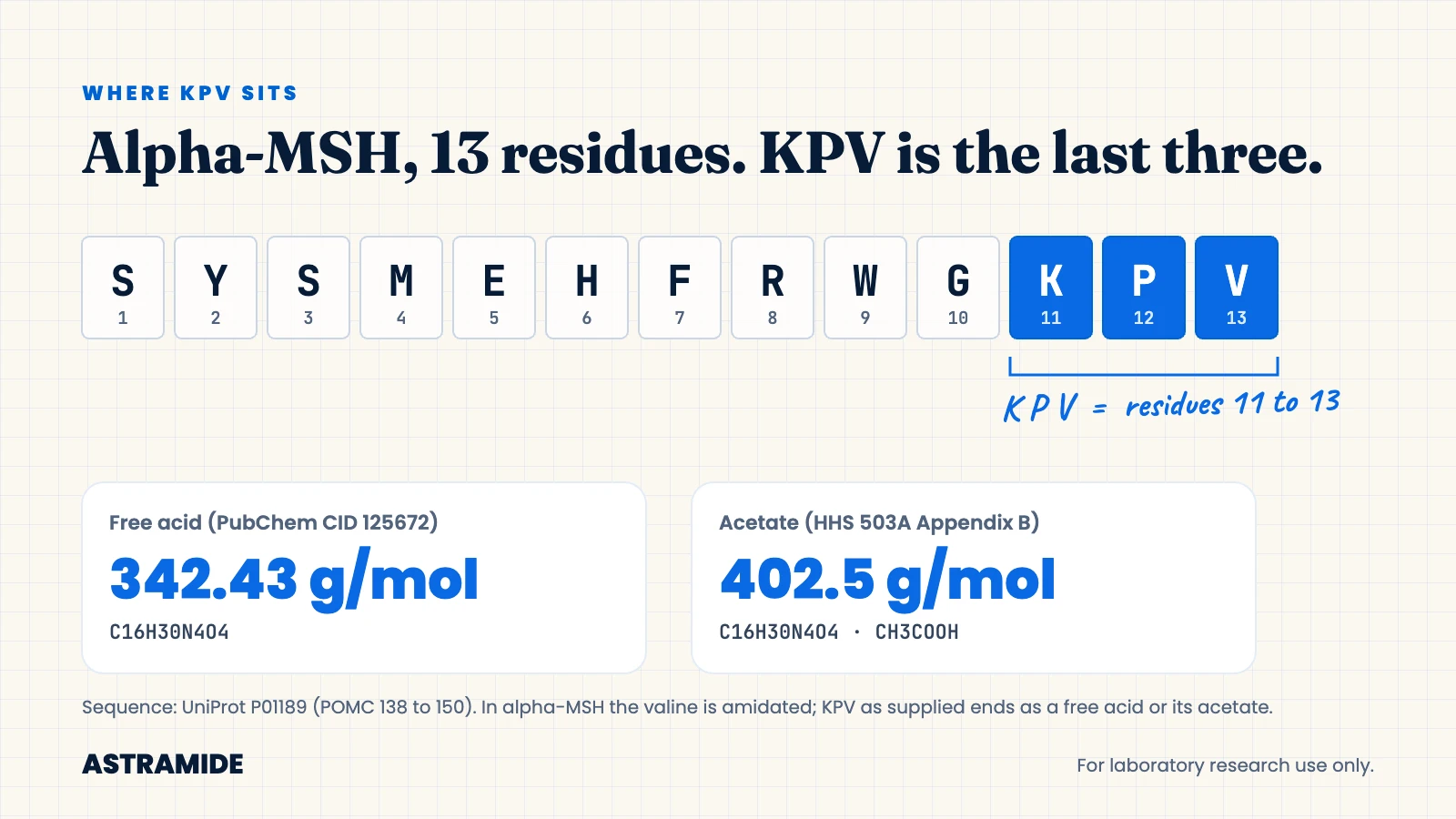
The two masses matter on a certificate. The acetate adds one acetic acid, about 60 g/mol, so it is about 17.5% heavier than the free acid. A mass match means something only against a stated reference form. The KPV Pro lot record states the free acid.
Where does KPV sit in alpha-MSH?
Alpha-MSH is residues 138 to 150 of the POMC precursor, with the sequence SYSMEHFRWGKPV (UniProt P01189). Count from the left: S is 1, and the final K, P and V are 11, 12 and 13. Those last three are KPV.
One structural detail differs. In alpha-MSH, the final valine carries a C-terminal amide. KPV as listed in PubChem and on the pH Solutions certificate is the free acid, ending in -OH (PubChem CID 125672).
A 2008 review placed KPV in a family of alpha-MSH-derived tripeptides, alongside the related tripeptide KdPT (Brzoska et al., 2008). The 1989 study described the C-terminal tripeptide as the message sequence of the parent hormone for one of its effects (Hiltz and Lipton, 1989).
what was measuredWhat does KPV do in research models?
"What does KPV peptide do" is best answered as what studies measured. KPV has been studied in inflammatory signalling research. The results below come from cells, mouse models and skin samples, not from people.
1989: ear swelling in mice
In a picryl chloride ear swelling model in mice, alpha-MSH 11 to 13 inhibited swelling. The response varied with the amount given to the mice (Hiltz and Lipton, 1989).
2000: microbes in culture
Alpha-MSH and KPV had antimicrobial influences against Staphylococcus aureus and Candida albicans in vitro. Effects were seen over a broad concentration range, including picomolar levels, and were linked to increased cAMP (Cutuli et al., 2000).
2008: NF-κB in intestinal and immune cell lines
In Caco2-BBE, HT29-Cl.19A and Jurkat cells, KPV at nanomolar concentrations inhibited NF-κB and MAPK activation and lowered pro-inflammatory cytokine secretion (Dalmasso et al., 2008). The same paper also used chemically induced (DSS and TNBS) mouse models.
2025: keratinocytes exposed to fine particles
HaCaT human keratinocytes were exposed to PM10 particulate matter. KPV at 50 µg/mL was associated with higher cell viability and lower IL-1β secretion, ROS, ERK and p38 signalling, NF-κB and caspase-1. The authors also used a 3D skin model (Sung et al., 2025).
2026: macrophages exposed to oxidized LDL
Mouse RAW264.7 macrophages were exposed to oxidized LDL. The study measured lipid accumulation and foam cell formation, which were lower with KPV in this cell line, along with ROS, p38 and NF-κB signalling, NLRP3 inflammasome assembly and IL-1β maturation. The authors reported no cytotoxicity in RAW264.7 cells at the concentrations tested (Bai et al., 2026). This was a mouse cell line, in vitro only.
Which research models have examined KPV?
Each cited study, by year, system and what was measured. "Skin in vitro" means human skin tissue studied in the lab.
| Study | Year | System | What was measured |
|---|---|---|---|
| Hiltz and Lipton | 1989 | Animal: picryl chloride ear swelling in mice | Ear swelling at several amounts |
| Cutuli et al. | 2000 | In vitro: S. aureus and C. albicans cultures | Antimicrobial influence across concentrations; cAMP |
| Dalmasso et al. | 2008 | Cells: Caco2-BBE, HT29-Cl.19A, Jurkat; animal: DSS and TNBS mouse models | NF-κB and MAPK activation, cytokine secretion, PepT1 uptake |
| Kannengiesser et al. | 2008 | Animal: DSS and CD45RBhi T-cell transfer mouse models, including MC1Re/e mice | Whether effects needed functional MC1R |
| Laroui et al. | 2010 | Animal: DSS mouse model; cells | Nanoparticle-encapsulated KPV in cells and a DSS mouse model |
| Pawar et al. | 2017 | Skin in vitro: dermatomed human skin | Permeation of KPV through skin tissue in vitro |
| Sung et al. | 2025 | Cells: HaCaT keratinocytes with PM10; 3D skin model | Viability, IL-1β, ROS, ERK/p38, NF-κB, caspase-1 |
| Bai et al. | 2026 | Cells: mouse RAW264.7 macrophages with oxidized LDL | Lipid accumulation, foam cells, ROS, NF-κB, NLRP3, IL-1β |
Two papers looked at how KPV moves. A 2010 study examined KPV loaded into nanoparticles in cell and mouse models (Laroui et al., 2010). A 2017 study measured KPV permeation through dermatomed human skin in vitro, as a physicochemical measurement (Pawar et al., 2017).
How does KPV enter cells? PepT1 and the melanocortin question
The KPV peptide mechanism question has two parts: how the tripeptide gets into cells, and which receptor, if any, it uses.
The PepT1 transporter
PepT1 is a membrane transporter for small peptides (Dalmasso et al., 2008). In the 2008 cell work, KPV competed with a radiolabelled PepT1 substrate for uptake. The authors concluded that KPV enters cells through PepT1 (Dalmasso et al., 2008).
Does KPV need melanocortin receptors?
Alpha-MSH acts on melanocortin receptors (Brzoska et al., 2008), so a natural question is whether its fragment does too. One 2008 study tested this directly. It used mice with a nonfunctional melanocortin 1 receptor (MC1Re/e). The effects of KPV were at least partially independent of MC1R signalling (Kannengiesser et al., 2008).
An earlier study in microbes linked the activity of alpha-MSH and KPV to increased cAMP (Cutuli et al., 2000). A 2023 review covered the wider melanocortin system in mouse intestinal models (Gravina et al., 2023). For background on the parent hormone and its tripeptides, see the 2008 review (Brzoska et al., 2008).
In short: PepT1 for uptake, and MC1R not required for every effect measured.
What is not known about KPV?
Four gaps stand out in the sources on this page.
- No clinical trial is among the cited studies. Every study above used cells, mice, microbes or skin tissue in vitro.
- Concentrations vary by orders of magnitude. One study reported effects at picomolar levels (Cutuli et al., 2000), another at nanomolar levels (Dalmasso et al., 2008). The 2025 study used 50 µg/mL (Sung et al., 2025).
- The receptor picture is incomplete. MC1R was not required for all effects (Kannengiesser et al., 2008), and the cited work names no single receptor in its place.
- The newest work is in cell lines. The 2026 study used a mouse macrophage line, in vitro only (Bai et al., 2026).
How do the two published KPV certificates compare?
Two published KPV lots, two labs, two test menus. Line by line, including what each does not report:
| Test | KPV lot 2026/02 (Krause Analytical) | KPV Pro lot NHS-KPV10-20260812-01 (pH Solutions Lab) |
|---|---|---|
| Lab reference | 205091 | NHS-KPV10-20260812-01 |
| Received and reported | April 28 and May 13, 2026 | September 23 and September 29, 2026 |
| Label amount | 10 mg | 10 mg |
| Identity | Confirmed by mass spectral match (HPLC-UV-MS) | Match: C16H30N4O4, 342.43 g/mol |
| Chromatographic purity | 99.6% (HPLC-UV/MS) | 99% (HPLC, 274 nm) |
| Endotoxin | <0.5 EU/mL (LAL, USP <85>) | Not reported |
| Appearance | Not reported | White to off-white lyophilized cake |
| Water content | Not reported | 0.0% (Karl Fischer) |
| Water activity | Not reported | 0.258 aw, pass |
| pH | Not performed | 7.0 |
| Microbial panel | Not performed | Pass: 10 organisms not detected in 1 g |
| Heavy metals | Not performed | Pass: As 0.003771, Cd 0.000, Pb 0.139549, Hg 0.000 ppm |
| Residual solvents | Not reported | Pass |
| Sterility | Not reported | Pass |
| Mycotoxins | Not reported | Pass |
Krause reports an endotoxin result that pH Solutions does not. pH Solutions reports nine further tests that Krause does not. "Not performed" means the Krause report lists the test and states it was not run. "Not reported" means the test does not appear on that certificate.
On identity, Krause reports a mass spectral match, while pH Solutions prints the free acid formula and mass it matched. Both purity figures come from HPLC, but at different detection settings, so the two numbers are not a direct ranking. Our guide to how HPLC and mass spectrometry differ explains what each method confirms.
What is the regulatory status of KPV?
This is general information, not legal advice.
KPV is not an FDA-approved drug. Astramide supplies KPV and KPV Pro as research chemicals, for research use only.
On October 30, 2026, HHS published an interim 503A enforcement discretion policy for listed peptides (FR Doc 2026-22192, 91 FR 68526). It lists six peptides, and KPV is one of them. Its appendix gives KPV as H-Lys-Pro-Val-OH acetate, C16H30N4O4·CH3COOH, 402.5 g/mol (HHS, 2026). Condition 7 limits the policy to a single listed active ingredient.
The listing does not make KPV an approved drug. The notice itself states: "Compounded drugs are not FDA-approved." The comment period closes November 13, 2026, under docket HHS-OASH-2026-0496.
For the full picture, read our HHS peptide policy explainer and our overview of whether peptides are legal.
published, lot by lotBatch Verification Standards
The two published KPV lots, as printed:
Chromatographic purity (HPLC-UV/MS)
99.6%
Chromatographic purity (HPLC, 274 nm)
99%
Both lots carry the same 10 mg label, and each record links to the full certificate. Both products are supplied for research use only. Both KPV lot records are in the Astramide COA library, and our testing process page explains how lot records are produced. For a field-by-field method, see how to read a peptide COA. Terms such as LAL and water activity are defined in the peptide glossary.
Frequently Asked Questions
KPV peptide is the tripeptide Lys-Pro-Val, the last three residues (11 to 13) of alpha-MSH. As a free acid it is C16H30N4O4, 342.43 g/mol. It has been studied in cell cultures, mouse models and human skin samples in vitro. It is not an FDA-approved drug. Astramide supplies KPV for laboratory research use only.
Studies have measured signalling markers. In cell lines, KPV at nanomolar concentrations was associated with lower NF-κB and MAPK activation and lower cytokine secretion (Dalmasso et al., 2008). Studies in 2025 and 2026 measured ROS, NF-κB and IL-1β in human keratinocytes and mouse macrophages (Sung et al., 2025; Bai et al., 2026). None of the cited studies is a clinical trial.
The free acid is C16H30N4O4, with a molar mass of 342.43 g/mol (PubChem CID 125672). The acetate salt listed by HHS is C16H30N4O4·CH3COOH, 402.5 g/mol. An earlier version of this page listed C11H21N3O3, which does not match KPV. Check which form a certificate used as its identity reference.
No. KPV is only the last three of the 13 residues of alpha-MSH, and it ends as a free acid rather than an amide. In mice with a nonfunctional MC1R, the effects of KPV were at least partially independent of MC1R signalling (Kannengiesser et al., 2008). Cell work pointed to the PepT1 transporter for uptake (Dalmasso et al., 2008).
By mass spectrometry, usually coupled with HPLC. The Krause record for lot 2026/02 reports a mass spectral match by HPLC-UV-MS. The pH Solutions record for KPV Pro reports a match to C16H30N4O4, 342.43 g/mol. A useful certificate states the reference form, free acid or acetate, because the two differ by about 60 g/mol.
No. KPV is not an FDA-approved drug. It is one of six peptides in the HHS interim 503A policy of October 30, 2026, which covers a single listed ingredient only. That listing does not make it approved; the notice states that compounded drugs are not FDA-approved. Astramide supplies KPV for research use only. This is general information, not legal advice.
They come from two labs with two test menus. Krause Analytical reported 99.6% purity, a mass spectral identity match and endotoxin below 0.5 EU/mL, with heavy metals, microbial and pH not performed. pH Solutions reported 99% purity, the matched formula, and passes for microbial, heavy metals, solvents, sterility and mycotoxins, but no endotoxin result.
Update log
- November 9, 2026: Rewritten. Corrected the molecular formula to C16H30N4O4, replaced the testing description with the two published lot records, added the 2025 and 2026 cell studies and the HHS policy status, linked every citation.
- July 19, 2026: Published.
Sources
- Hiltz ME, Lipton JM. FASEB J. 1989;3(11):2282-4. PMID 2550304. PubMed
- Cutuli M, Cristiani S, Lipton JM, Catania A. J Leukoc Biol. 2000;67(2):233-9. PMID 10670585. PubMed
- Dalmasso G, et al. Gastroenterology. 2008;134(1):166-78. PMID 18061177. PMC2431115
- Kannengiesser K, et al. Inflamm Bowel Dis. 2008;14(3):324-31. PMID 18092346. PubMed
- Brzoska T, Luger TA, Maaser C, Abels C, Bohm M. Endocr Rev. 2008;29(5):581-602. PMID 18612139. PubMed
- Laroui H, et al. Gastroenterology. 2010;138(3):843-53. PMID 19909746. PubMed
- Pawar K, Kolli CS, Rangari VK, Babu RJ. J Pharm Sci. 2017;106(7):1814-20. PMID 28343991. PubMed
- Gravina AG, et al. Cells. 2023;12(14):1889. PMID 37508552. PMC10378568
- Sung J, et al. Tissue Cell. 2025;95:102837. PMID 40073467. PubMed
- Bai JS, et al. Tissue Cell. 2026;104:104036. PMID 42854645. PubMed
- US HHS. 503A Peptide Enforcement Discretion Policy, Appendix B. 2026. HHS PDF
- US HHS. Federal Register. FR Doc 2026-22192, 91 FR 68526. October 30, 2026. Docket HHS-OASH-2026-0496. Public inspection PDF
- Databases: PubChem CID 125672; UniProt entry P01189.
All products are intended for research and identification purposes only. These products are not intended for human dosing, injection, or ingestion. The statements on this website have not been reviewed by the FDA. These research peptides are not intended to diagnose, treat, cure, or prevent any disease.